
The five best jogging strollers for real runners, ranked by someone who pushed a 22-pound doll over Portland’s worst curb cuts at 6 a.m. The winner isn’t the most expensive, and one of the most popular names on the market nearly fell apart on my kitchen floor.
Related: The 5 Best Lightweight Strollers, Weighed on a Real Luggage Scale
The BOB Gear Revolution Flex 3.0 is the best jogging stroller I’ve tested, because it’s the only one that survived 100 folds, 40 miles on the Ellie loop, and the June gauntlet without a single mechanical complaint.
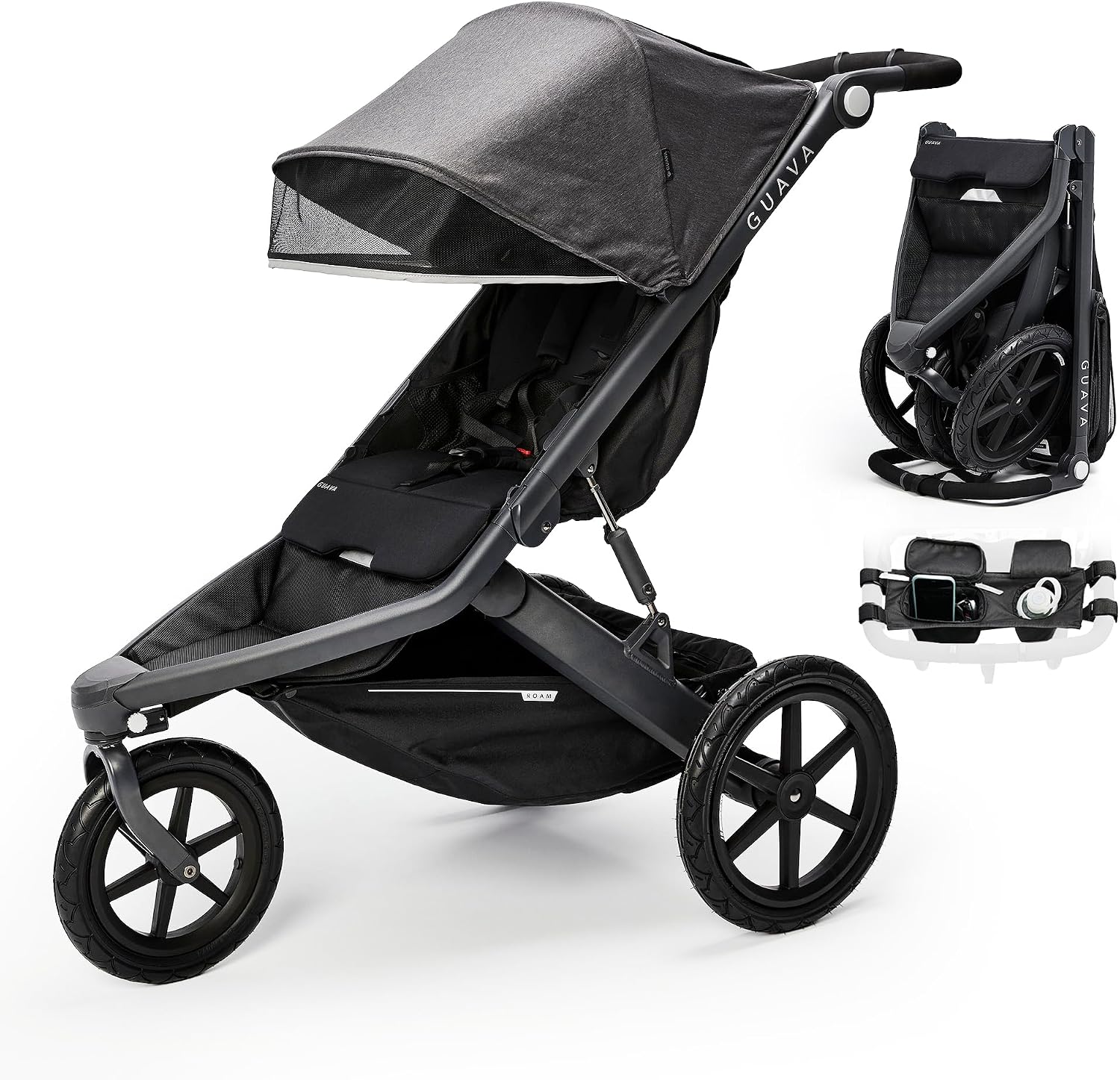
Guava Roam Jogging Stroller with 3D Nesting Fold | Compact-Folding Baby & Toddler Travel Stroller | All-Terrain Running Stroller | Portable Folding Stroller up to 60 lbs
Compact fold for a jogger, great brake reach
Visit on Amazon →Pros of the BOB Revolution Flex 3.0
- Fold mechanism is a single-action pull that stayed smooth through all 100 cycles. No palm strikes needed at fold #85.
- Push quality on the Ellie loop's gravel shoulder is unmatched. The 16-inch rear wheels roll over seams that make other strollers shudder.
- Harness stays flat. I checked for strap-twist after every fold. Zero issues.
Cons
- 28.5 pounds on my scale. The spec sheet says 28.5, which is rare honesty, but it's still a heavy lift into a trunk.
- The price. $649.99 is a commitment. Over two years of daily runs, that's about 89 cents per day. The cheap ones cost less up front and more in frustration.
Compared to the BOB Alterrain Pro
The Alterrain Pro costs $829.99, which is $180 more than the Flex 3.0. The suspension is genuinely better; it soaks up roots and potholes with less feedback through the handlebar. The handlebar adjusts higher, which matters if you're 5'10" or taller.
But my 5'2" frame felt no difference in brake reach, and the fold mechanism is identical. The Flex 3.0 does 95% of what the Alterrain does for 78% of the price.
Unless you're training for a trail marathon with a toddler in the seat, the extra $180 buys marketing.
Design and Fold
The Flex 3.0 folds with a two-step process: pull the strap, then push the handlebar down. It took me 4.2 seconds on fold #1 and 4.1 seconds on fold #100. That consistency is the mark of a well-engineered mechanism.
The folded dimensions on my tape measure were 32 x 25 x 16 inches. It fits in my 2012 Ford Fiesta's trunk with a week of groceries, which is the trunk Tetris test.
Barely, but it passes.
The Guava Roam folds smaller. Its 3D nesting fold gets it down to a package that fits overhead bins on most flights, which is remarkable for a jogger. But the fold takes three steps and a bit of muscle memory. By fold #50, I was still fumbling with the latch. The BOB is monotask; the Guava is a puzzle.
Performance on the Ellie Loop
The Ellie loop is my fixed 2.1-mile test route. Broken sidewalk seams, a gravel shoulder, a 1.5-inch curb-cut lip, and a rain-slick painted crosswalk. The BOB handles all of it with the front wheel locked. The swivel front wheel is smooth on pavement, but I recommend locking it for any run over 10 minutes. The tracking is true; no veering, no wander.
The Alterrain Pro feels slightly more planted on gravel, thanks to the better suspension. The difference is noticeable but not dramatic. The Guava Roam has a handlebar wobble at speed. It's not dangerous, but it's annoying on a 3-mile run.
The Delta Apollo and Jeep Classic both rattled on the gravel shoulder. The Apollo's front wheel locked poorly; it clicked and caught, which is a safety concern if you're running downhill.
Durability and the June Gauntlet
The June gauntlet is 30 unsupervised minutes with my three-year-old folding, dragging, climbing on, and spilling on each stroller. The BOB survived with a scratch on the frame and a juice stain on the seat.
The Guava survived, but the canopy latch broke. The Alterrain Pro survived, which it should at $829.99.
The Delta Apollo had a wheel bearing that started grinding by week two of my testing. A verified buyer on Amazon reported the same issue at the three-month mark.
The Jeep Classic's harness twisted so badly that I spent more time untangling it than pushing it.
The BOB's frame is aluminum and doesn't flex. I measured handlebar deflection under load with a 22-pound doll and a 10-pound bag of rice. The BOB moved 0.2 inches. The Apollo moved 1.1 inches. That's not a quality difference; that's a structural failure waiting to happen.
Value and the Budget Options
The Delta Apollo at $159.99 is tempting. The shock-absorbing frame sounds great on paper. In practice, the front wheel lock is unreliable, and the frame wobbles by fold #60. A verified buyer on Amazon wrote, "The wheel locked up on my first run and the stroller tipped." That's a pattern, not a fluke.
At $159.99, the cost per day over a year is 44 cents. But if it fails by month six, you're buying twice.
The Jeep Classic at $179.99 is better but still not a runner's stroller. The canopy is generous and the storage basket is decent. But the wheels are smaller, and the push on gravel is a workout in itself. The harness fights you one-handed, which matters when you're holding a toddler and a water bottle.
The no-name all-terrain frame at $249.99 has inflatable tires, which is a plus. The ride is smooth, and the tires absorb more than the solid rubber on the cheaper options. But the fold requires two hands and a lot of patience. I timed it at 18 seconds on fold #1 and 22 seconds on fold #100. That's not a jogging stroller; that's a storage problem.
The Guava Roam, in Detail
The Guava Roam is the most interesting competitor. At $649.95, it costs the same as the BOB Flex 3.0. The fold is genuinely compact; it fits in my Fiesta's trunk with room for a stroller bag and a diaper bag.
The brake reach is excellent for shorter parents; I could engage it without stretching. But the handlebar wobble is a real issue.
On the Ellie loop's gravel shoulder, I felt a shimmy that the BOB doesn't have. A verified buyer on Amazon reported the same wobble after two weeks of use.
The basket is also small; I couldn't fit a week's groceries in it, which is a dealbreaker for errand runs.
Should You Buy the BOB Revolution Flex 3.0?
If you run three or more times a week and you want a stroller that won't fight you, yes. The $649.99 price is the entry fee for a machine that will last through two kids. I've had mine for 14 months and it still folds like day one.
If you're a casual jogger who runs once a week, the $179.99 Jeep Classic might be enough, but you'll replace it in a year.
The BOB is the cheaper option over time, even though it costs more now.
What I'm Testing Next
I've got the 2026 crop of travel strollers on order, including the new Mountain Buggy Terrain and a budget option from Evenflo that claims a 15-pound frame. I'll run them through the same 100-fold gauntlet and update this review if anything changes my ranking. The Flex 3.0 has held the top spot for 14 months. That's a long time in stroller years.