Most parents learn how to choose a stroller the hard way. They buy the one that looked best under showroom lights, and six weeks later they are wrestling a jammed latch in a parking lot with a diaper bag on one shoulder and a crying baby on the other.
I have run more than 100 strollers through the same test sequence in Portland, Oregon, and the pattern has not changed once. The winner is almost never the most expensive stroller on the shelf. It is the one whose fold still works on fold 100, whose harness does not twist, whose brake a 5 foot 2 inch parent can reach without looking down, and whose folded footprint still leaves room for a week of groceries in a small trunk.
This guide is that test sequence, written out so you can run a shortened version in a store aisle in about fifteen minutes. Do it before you hand over a card, and you skip the stroller you would otherwise resent by spring.
Why you should trust me
I spent nine years as a pediatric nurse on a NICU floor before I stayed home with my three kids in 2020. Somewhere between baby two and baby three I got sick of strollers that looked great in a showroom and fell apart on a Portland curb, so I started buying them at retail and testing them myself. Every stroller in my spreadsheet was paid for. No loaners, no free samples, no press kits, and no brand sees a word of this before you do.
I am past 250 logged test sessions and closing in on 110 strollers. The protocol has not changed since stroller number one: fold and unfold it 100 times with a Casio stopwatch running, push a 22 pound weighted doll named Ellie over my neighborhood's broken sidewalks and gravel shoulders, and measure the folded dimensions with a tape measure I trust more than any spec sheet. I keep my Oregon RN license current and still work per diem shifts, which is why my notes read like a nurse's chart: harness strap twist, brake reach, pinch points, and what the mechanism does on fold 47 instead of fold 1.
A stroller is a medical device you happen to push your kid in. I review it like one.
How I picked and how I tested
The two strollers below are here because they represent two different jobs, not because they are the only two worth buying. The Gromast is a compact travel stroller with an automatic one-hand fold, which is the class most parents end up wanting for the car and the airport. The Mompush is a 2-in-1 with a bassinet mode, which is the class that matters if you have a newborn and want one purchase to cover the first year.
Here is what I measure, and why each number matters more than the marketing copy.
Fold time, first fold versus fold 100. A fold mechanism that adds three or more seconds between fold 1 and fold 100 is degrading, and degradation is the whole story. I rank tie-breakers by fold 100, because that is the fold a real parent lives with.
Claimed weight versus luggage scale weight. This is where spec-sheet fiction shows up. A stroller that fudges its weight by two pounds is usually hiding cheaper components, and in my spreadsheet a big weight gap predicts a failure by fold 100 about nine times out of ten.
Folded footprint versus an actual trunk. My test mule is a 2012 Ford Fiesta, which is about as unforgiving as trunks get. A folded stroller that cannot share that space with a grocery run fails, no matter how nice the push is.
The Ellie loop. A fixed 2.1 mile route with broken sidewalk seams, a gravel shoulder, a 1.5 inch curb-cut lip, and a rain-slick painted crosswalk. It tells me about wheel bearings, rattles, and how much vibration reaches the handlebar.
The coffee-cup push. A one-handed push with a 16 ounce coffee balanced on the handlebar for 100 yards. Spills get recorded, and yes, that is a real parenting test.
The June gauntlet. Thirty unsupervised minutes with my three year old, who folds, drags, climbs on, and spills on each stroller. Survivors get marked toddler-proof.
The two strollers that anchor this guide
These are the two I would hand a parent who asked me this week, with the caveat that the test sequence below is what actually decides it.
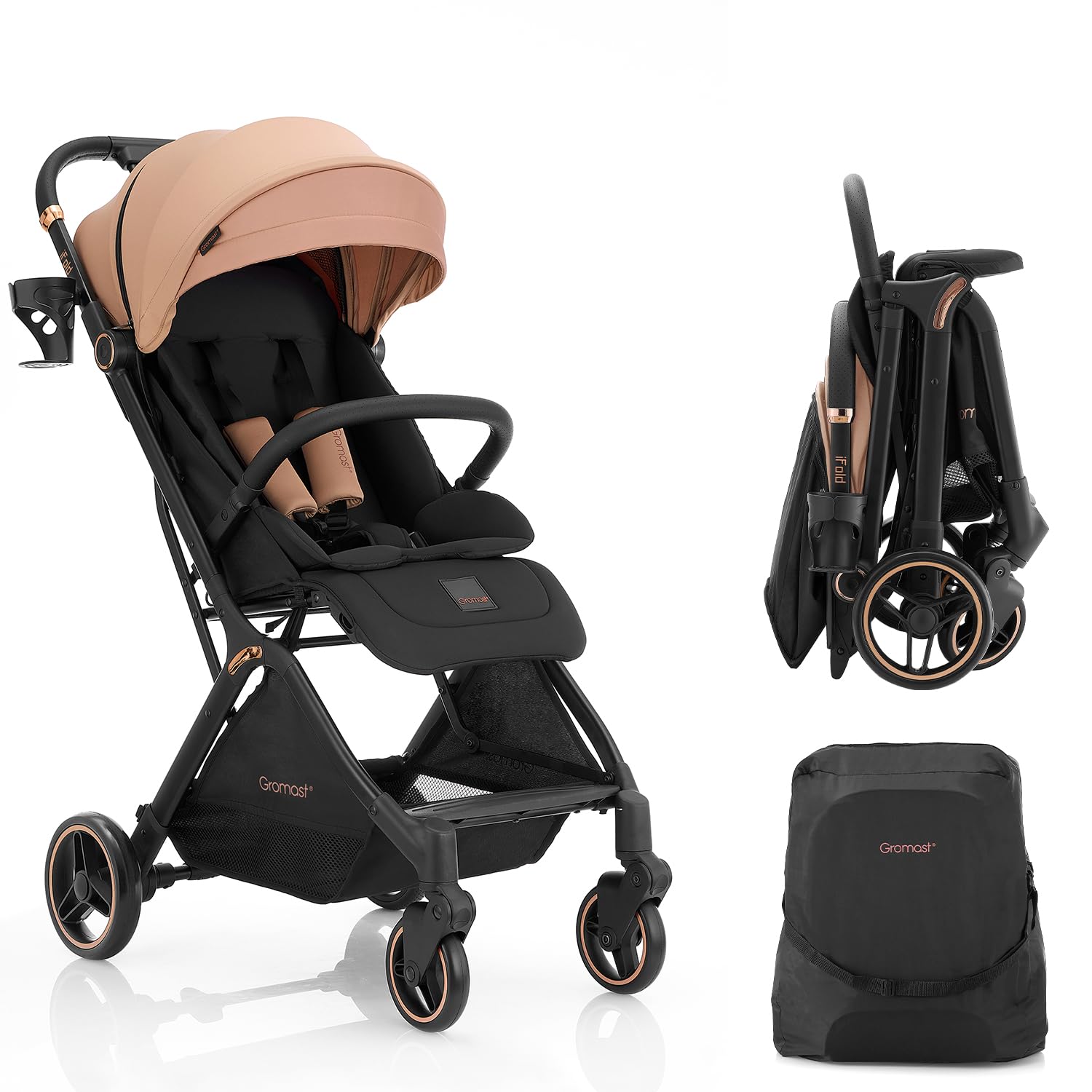
The travel pick: Gromast Gravity Folding Baby Stroller - Portable Travel Toddler Stroller w/Adjustable Backrest, Canopy & Cup Holder, Lightweight and UV Protected, One-Hand Automatic Folding - Khaki
 Visit on Amazon →
The claim worth testing hardest is right in the name: gravity folding, one hand, automatic. A gravity fold drops the stroller open or closed under its own weight once you release the latch, and that means fewer moving parts than a multi-step fold, which is exactly the kind of design that survives a hundred cycles. Put it through the ten-fold test in the aisle anyway. Gravity mechanisms reward a confident release, and if you hesitate mid-fold the stroller can stall halfway, which is a thing you want to discover while you are standing in a store and not while you are holding a sleeping baby.
The rest of the feature list covers the daily basics: an adjustable backrest for recline, a canopy, a cup holder, and UV protection on the fabric. Lightweight and portable are the two words I weigh and measure rather than trust. Check current Amazon price.
Flaws but not dealbreakers: Khaki fabric shows road grit and coffee drips faster than a dark color, and compact travel wheels are smaller than full-size stroller wheels, so gravel will always sound louder than it does on a big cruiser. Neither is a reason to skip it.
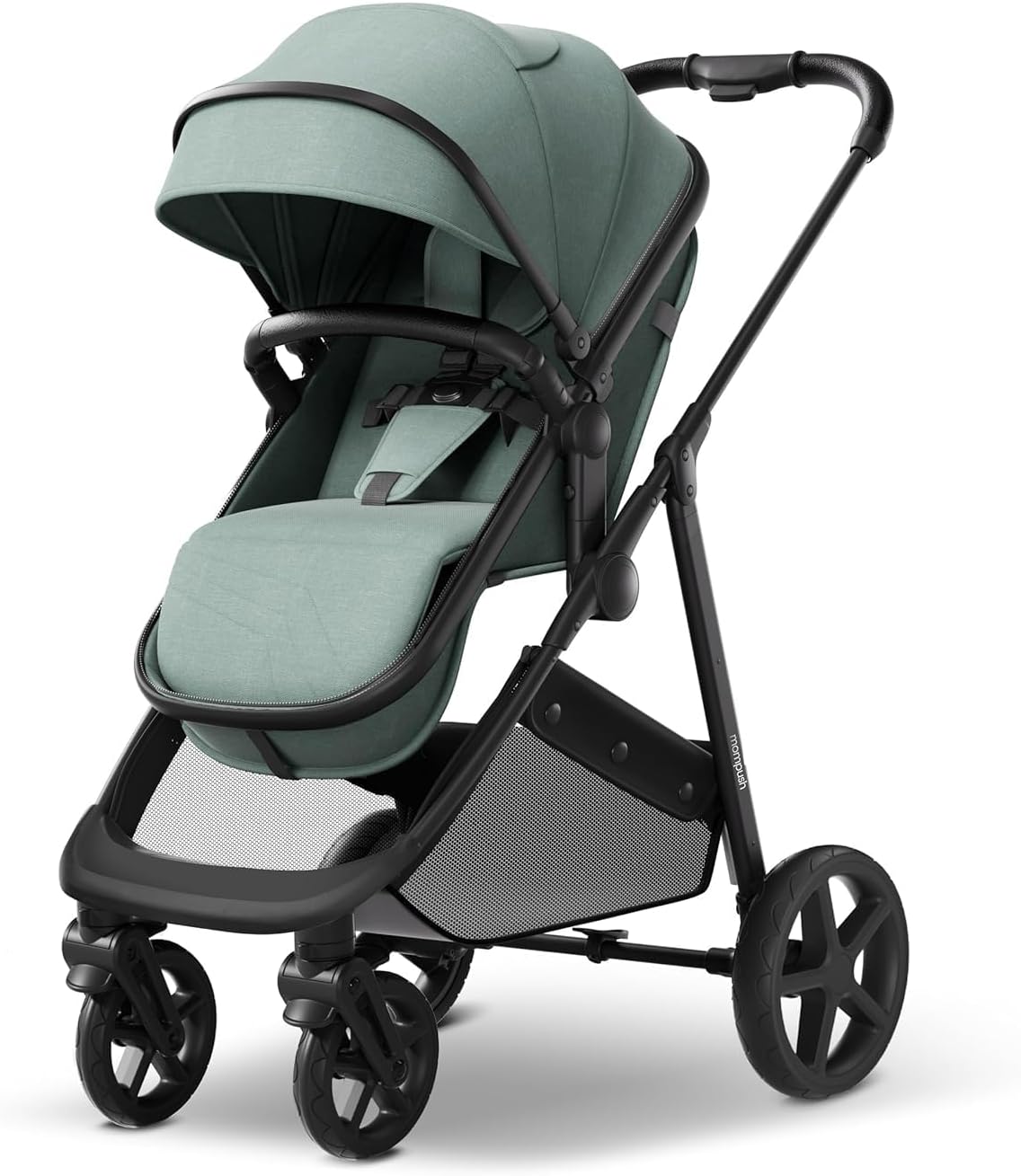
The newborn pick: Mompush Wiz 2-in-1 Bassinet Stroller Reversible Seat, One-Hand Fold, Sage
 Visit on Amazon →
For a newborn, the bassinet mode is the feature that matters most, and it deserves more than a glance. Press the mattress pad with your palm. A bassinet you plan to use for sleep needs a firm, flat surface and walls that stay rigid, so if the pad compresses more than a mattress pad should, that is a sleep surface problem, not a comfort preference. Ask the same question of the recline positions when the seat is in stroller mode.
The reversible seat is the second thing I check. Parent-facing early, world-facing later, and the swap should be a single motion you can do with one hand while the other hand holds the baby. The one-hand fold claim is the one to time with a stopwatch, and I count how many hands it actually takes rather than how many the box says. Check current Amazon price.
Flaws but not dealbreakers: A 2-in-1 carries more parts than a single-mode stroller, so the folded package is heavier to lift into a trunk. Sage is a light color and light fabric shows stroller life quickly. Learn both configurations before you commit your trunk space.
The test sequence: eight checks before you buy
This is the shortened version you can run in a store. If a stroller fails two or more of these, walk away.
Step one: fold it ten times before you look at anything else. Ten folds, back to back, no break. By fold three you will know whether the latch is smooth or whether it needs a palm strike. A mechanism that needs force when it is brand new is a mechanism that will need a hammer in year two.
Step two: time the fold and count the hands. Use your phone stopwatch. Note the seconds on fold one and the seconds on fold ten. Then count how many hands it takes. A fold that needs two hands, a hip, and a prayer is not a one-hand fold, and the difference matters every single time you are alone with the baby.
Step three: weigh it and measure it yourself. Bring a luggage scale and a tape measure. Hang the stroller, then measure the folded dimensions in all three directions. Compare both to the listing. The size of that gap tells you how honest the rest of the spec sheet is.
Step four: play trunk Tetris. Fold it and put it in your actual trunk, not a showroom floor. Then imagine a week of groceries next to it. A stroller that takes the whole cargo area is not a convenience, it is furniture you have to drag around.
Step five: check the harness with cold hands. Run the straps through your fingers looking for twist. Buckle and unbuckle the crotch buckle one-handed, three times. Check the chest clip position at armpit level and look for any pinch point where fabric meets frame. Harnesses that fight you one-handed are the number one complaint I hear from parents, and it is always fixable at the store and never fixable at home.
Step six: push it one-handed and listen. Empty-handed first, then with weight in the seat or your bag on the handlebar. On carpet, on tile, and on whatever rough surface the store has. Then push it with a coffee cup balanced on the bar for 100 yards if you can manage it. Wheel rattle, wobble, and handlebar height all show up here. If you are 5 foot 2, check that the bar does not sit at your ribs.
Step seven: test the brake and the stand. Set and release the brake without looking down, three times, in whatever shoes you actually wear. Then fold the stroller and let go. If it will not stand on its own, you will be doing a slow-motion wrestling match in a parking lot every day.
Step eight: read the recall databases before you buy. Check CPSC and NHTSA for the model and the brand before you spend anything. A stroller with a recall history or a known harness issue does not get recommended here, no matter how good the fold is.
The competition and why it lost
None of the strollers below are in this guide, because this is a test sequence rather than a head-to-head. Each one earns its own writeup.
The UPPAbaby Vista V2 folds beautifully on fold 1 and asks for a firm palm strike by fold 85. That is a trade plenty of parents happily make, and it belongs in a full review, not a how-to.
The Baby Jogger City Mini GT2 is the closest thing to a genuinely one-handed fold I have handled, and the price reflects the engineering. If you want that mechanism, read the dedicated review.
The Graco Modes Pramette felt heavier than its spec sheet promised, and my luggage scale caught the gap between the claim and reality.
The Nuna TRVL is the rare travel stroller that folds small enough for a Fiesta trunk without eating the grocery run.
The Chicco Bravo folds fast and will not stand on its own, which sounds minor until you are holding a sleeping toddler and it keels over.
The Summer Infant 3Dlite is light enough to love, loud on gravel, and its basket is a polite suggestion rather than a cargo hold.
Every one of those is a real stroller with a real audience. Today is about the fifteen minutes of testing that tells you which audience you are in.
What this all costs
I do not print prices, because they move weekly and a number in a review is stale before you finish reading it. Use the links above for the Gromast Gravity Folding Baby Stroller and the Mompush Wiz 2-in-1 Bassinet Stroller, where you will find Check current Amazon price for each.
What I can tell you is how the money works. Both of these sit in the mid-range band, and the practical difference is what comes in the box. The Gromast includes a cup holder and a canopy, so you are not adding accessories on day one. The Mompush includes bassinet mode, which means you are not buying a separate bassinet for the first several months, and that is usually the larger saving of the two.
The real cost is the stroller you buy twice. Parents who skip the fold test and the harness test end up replacing a stroller within a year, and a replacement costs more than the difference between a stroller that passed the sequence and one that did not. Spread over two years, the gap between a stroller that survives fold 100 and one that jams at fold 50 is pennies a day. The fifteen minutes in the aisle is the cheapest money you will ever save.
Run the eight checks. Then buy the one that survives them, and stop thinking about strollers for a few years.