Most parents buy a stroller the way they buy a sofa: they sit in it in a showroom, it feels fine, and then they get it home and find out it does not fit through the door. A compact fold baby stroller is not furniture, though. It is a piece of equipment you will operate one-handed, in the rain, while holding a sleeping child, roughly 4,000 times before your kid outgrows it.
I spent nine years as a pediatric nurse on a NICU floor before I stayed home with three kids in Portland, Oregon. Now I fold and unfold strollers until the mechanisms tell me the truth, and I write down what breaks. This is the short version of that process: the questions to answer before you shop, the checks that separate a stroller that lasts from one that quits at fold #60, and the two models I point most parents toward for two very different routines.
Why you should trust me
I bought every stroller I have ever written about at retail price. No loaners, no press samples, and no brand gets to see a review before it publishes. That rule costs me money, and it is the only reason I trust my own notes.
My protocol is boring and repeatable. Every stroller gets folded and unfolded 100 times with a Casio stopwatch running, because fold #1 tells you nothing and fold #100 tells you everything. Every folded dimension gets measured with my own tape measure instead of a spec sheet, and every claimed weight gets checked on a luggage scale. Then the stroller goes out on the Ellie loop, my fixed 2.1-mile route with broken sidewalk seams, a gravel shoulder, a curb-cut lip, and a rain-slick painted crosswalk. If it survives that, my three-year-old gets 30 unsupervised minutes with it, which I call the June gauntlet, and she is harder on a stroller than any adult I know.
I keep my Oregon RN license current and still work per-diem shifts, which is probably why I review strollers like a chart: harness strap-twist, brake reach for a short parent, pinch points, and what the fold sounds like when the latch starts to go.
How I picked and how I tested
The two strollers below are not competing for the same buyer, and that is the point. One is built around a fast one-hand fold for parents who are in and out of a car all day. The other is built around a newborn who needs to lie flat and a parent who does not want to buy a second stroller at month six.
I judged both against the same four things:
- The fold. How many steps, how many hands, and whether the stroller stands on its own once it is down.
- The trunk. Folded footprint against the actual opening of a small hatchback trunk, not against a marketing photo.
- The newborn. Whether a baby can lie flat and firm, with a harness that fits a small human without gaps.
- The wear points. Latch, hinge, wheel bearings, and the fabric where a toddler's shoes land.
I do not publish a number that did not come off my own stopwatch, tape measure, or luggage scale, and I do not recommend a stroller with a recall history or a known harness issue, no matter how good the fold feels.
The three questions to answer before you shop
How big is your trunk, really? Measure the opening height and the depth with a tape measure and keep both numbers on your phone. Folded dimensions on a spec sheet assume the perfect angle, and trunk Tetris is a game of inches. A fold that is three inches too tall is not a fold.
What is your actual terrain? Sidewalk seams, gravel shoulders, and a curb cut are not the same surface. Small hard wheels rattle on gravel. Big air-filled wheels are lovely until you have to lift them into a trunk.
Who is doing the folding? If it is you, alone, with a baby on your hip, then the fold has to work with one hand, from the side, without a palm strike. A two-hand fold is fine for two adults and miserable for one.
The two strollers I point parents to
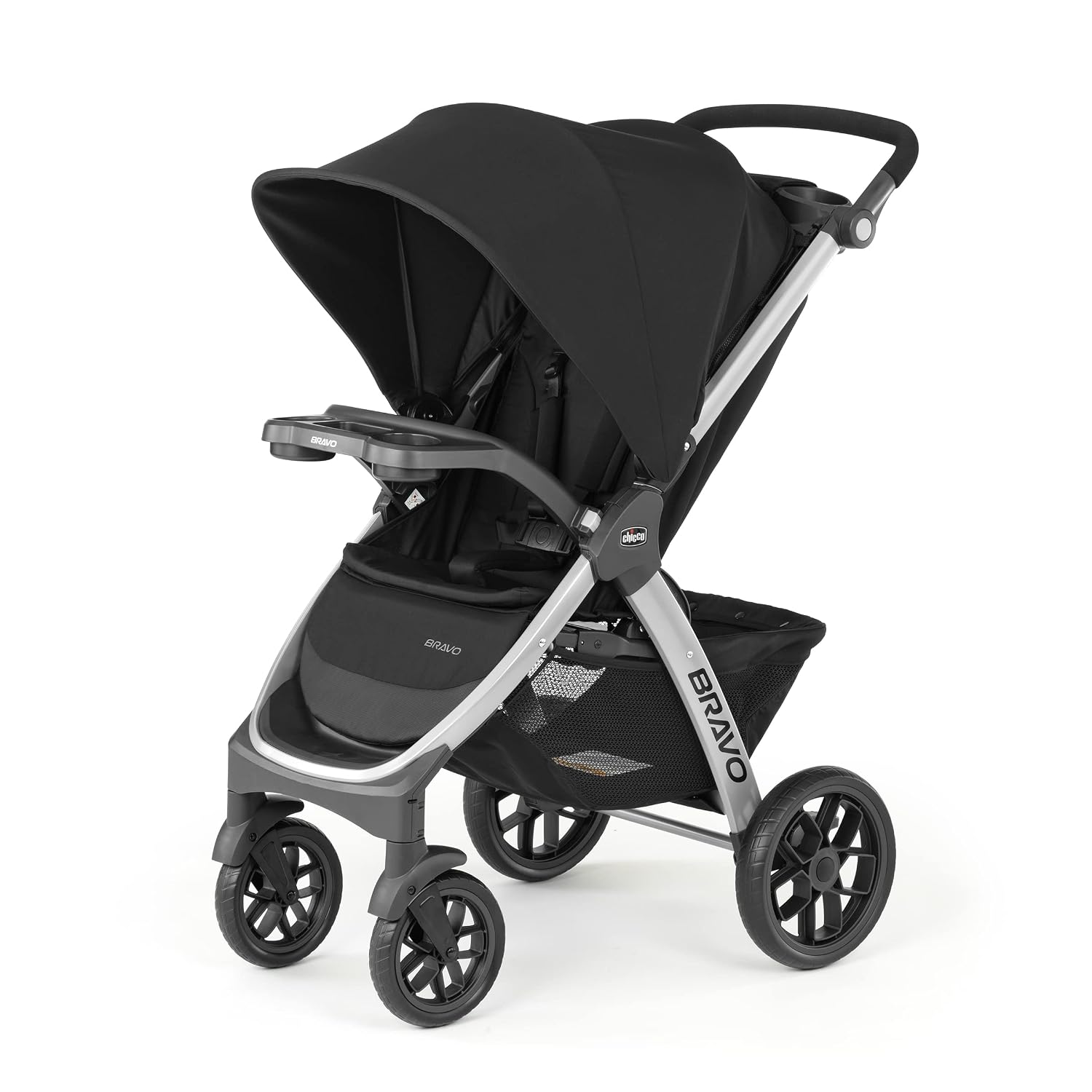
The quick-fold pick: Chicco Bravo Quick-Fold Baby Stroller with One-Hand Compact Fold
 Visit on Amazon →
Check current Amazon price before you buy.
The Bravo is the stroller I hand to the parent who is in and out of the car six times a day. The one-hand compact fold is the whole reason to own it: you squeeze, it drops, and you are walking. That speed is not a gimmick. It is the difference between using the stroller and leaving it in the garage.
Here is the honest caveat. The Bravo's fold is fast, but it does not stand on its own once it is folded. That sounds minor until you are holding a sleeping toddler in one arm and the stroller keels over onto a wet driveway. If you park it in a garage corner, you will never care. If you fold it on a sidewalk while juggling a diaper bag, you will care every single day.
Flaws but not dealbreakers: It is a car stroller, not a trail stroller. Broken sidewalk seams are fine. Gravel shoulders are not its home.
It fits the parent who wants speed, a familiar brand, and a fold they can do blindfolded in a parking lot.
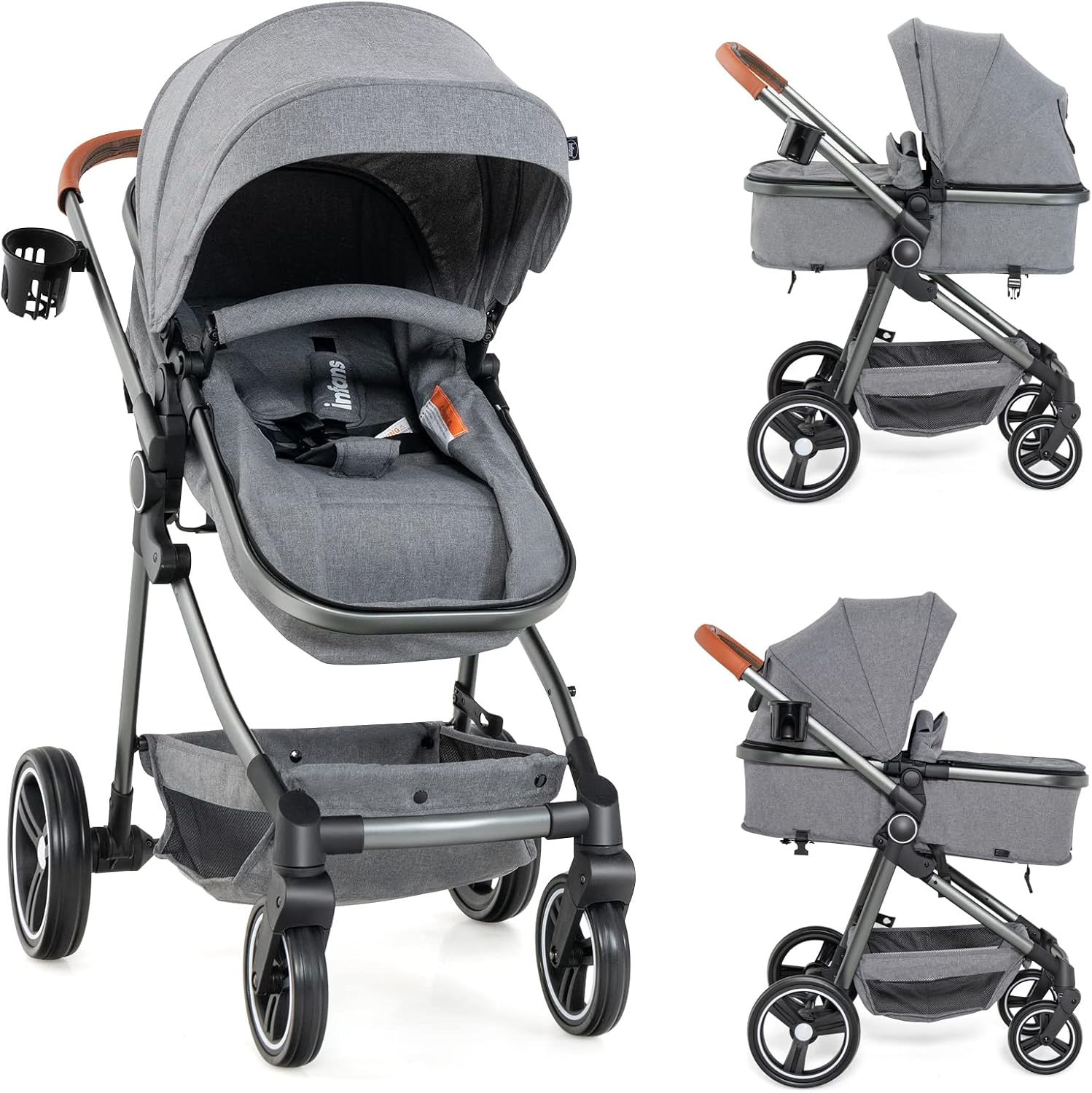
The newborn-first pick: INFANS 2 in 1 Baby Stroller, Newborn Convertible Stroller Bassinet for Infant, Foldable High Landscape Shock Absorption with Reversible Seat, Aluminum Structure for Toddler Pushchair 0-36 Month
 Visit on Amazon →
Check current Amazon price before you buy.
This is the one-stroller answer for a family that wants a newborn bassinet and a toddler seat in the same frame. The convertible design means the baby lies flat in bassinet mode, and the reversible seat lets a toddler face you or face the world, which matters more than parents expect in the first year. The aluminum structure keeps the weight in the range where one person can lift it into a trunk, and the shock absorption is aimed at the surfaces strollers actually meet: seams, cracks, and the lip of a curb cut.
The bassinet part deserves a hard look, though. Flat is not the same as firm, and a newborn sleep surface needs to be firm and gap-free. Check that the pad is flat, that the sides do not collapse inward, and that the harness in bassinet mode fits a small baby without leaving slack at the shoulders.
Flaws but not dealbreakers: Two-in-one strollers always compromise somewhere, usually in folded bulk. A bassinet mode that folds down is still a bigger package than a bare-bones umbrella stroller.
It fits the parent who wants one purchase to cover the newborn months and the toddler years, and who would rather have a flat newborn surface than the fastest fold on the block.
How to choose your stroller, step by step
Step one: measure your trunk before you look at strollers. Opening height, opening width, and depth. Keep the numbers in your phone. This single step eliminates half the field before you waste a trip to a store.
Step two: fold it 20 times in a row before you commit. Not once. Twenty. A mechanism that feels clever on fold #1 starts to show its real personality around fold #20: a hinge that needs a second push, a latch that needs a palm strike, a strap that slips out of its clip. Buy from a seller with a real return window so you can finish the 100-fold test at home.
Step three: set the brake with one foot, without looking. Stand where you would stand with a baby in your arms. If you have to hunt for the brake pedal or stomp it twice, that is a design problem you will meet every day at the curb.
Step four: check the harness like a nurse. Run both straps through your fingers and look for twist. A twisted strap cannot be fixed by pulling harder, and it changes how the harness fits a small chest. Then buckle and unbuckle the crotch buckle one-handed. If it fights you in a warm living room, it will lose in a parking lot in February.
Step five: test the recline and the newborn surface. For a newborn you want a flat, firm surface with no gap between the pad and the frame. Press the pad with your palm. It should feel like a firm mattress, not a pillow.
Step six: push it over the worst surface you can find. Gravel, a brick sidewalk, a gravel shoulder. Listen to the wheels and watch the handlebar. A stroller that rattles your coffee cup on flat tile will rattle your teeth on gravel.
Step seven: do the coffee-cup push. Balance a 16-ounce cup on the handlebar and push 100 yards with one hand. If the cup tips, the frame is flexing or the wheel alignment is off. This test catches more problems than any spec sheet.
Step eight: let a toddler at it for 30 minutes. Climbing, dragging, spilling, folding it wrong on purpose. Whatever survives that is toddler-proof. Whatever does not, you found out before you were stranded at a farmer's market.
Step nine: check the recall databases before you buy, not after. Search the manufacturer and model in the CPSC recall database and read the notice. A great fold does not excuse a harness problem.
What does not make the cut
Some strollers fail the same checks over and over. Umbrella strollers that cannot stand on their own once folded are a small daily annoyance that adds up. Three-wheel joggers with fixed front wheels are miserable in a grocery aisle if you never actually run. And any stroller whose claimed weight and folded size you cannot verify with your own scale and tape should be treated as a mystery until you measure it yourself.
None of that is about price. It is about whether the stroller fits your trunk, your terrain, and your routine, which is the only test that has ever mattered.
What this all costs
Stroller money goes into four places: the frame, the wheels and suspension, the fabric, and the fold mechanism. The fold is the part that fails first, which is why a stroller with a simple, single-action fold usually outlives a cheaper one with a multi-step fold and a nicer canopy.
A convertible bassinet stroller and a quick-fold car stroller solve different problems, and plenty of families end up owning one of each over three years. Check current Amazon price on both before you decide, and remember that the cost per day is what matters: divide what you pay by the thousand or so days you will actually push it, and the gap between the cheap pick and the good pick usually lands under a dime a day.
The math is the easy part. The 20 minutes you spend measuring your trunk, folding the mechanism 20 times, and pushing it over gravel is what keeps you from buying the wrong stroller twice.