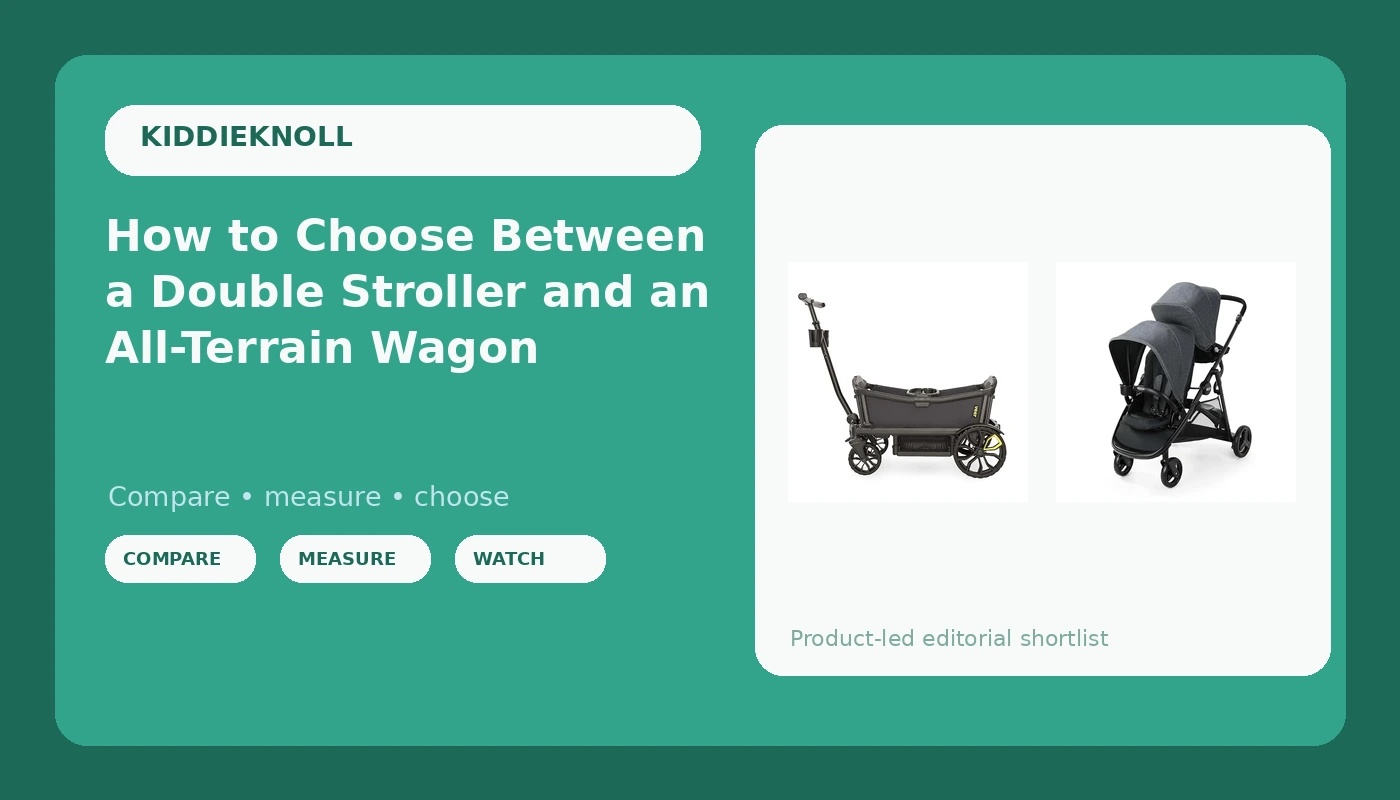
Double stroller vs wagon is the question that fills my inbox more than any other, and it almost never gets settled by the price tag. It gets settled by your trunk, your doorways, and how many children you are actually pushing at 4:45 in the afternoon when everyone is tired and nobody wants to climb into anything.
I spent nine years as a pediatric nurse on a NICU floor before I stayed home with three kids, and I have been buying strollers at retail and running them through a fixed test protocol in Portland's Sellwood neighborhood ever since. The two shapes parents ask about most are the bench-seat double stroller and the all-terrain wagon, and they solve genuinely different problems. One is built around two kids sitting. The other is built around two kids getting in and out.
Here is the short answer before the long one. If your children are close in age and both ride most of the time, buy the double stroller. If they are spread out, if one of them walks half the route, or if your daily path includes gravel, dirt, or a beach, buy the wagon. The rest of this article is how to confirm which of those is true for your family, and what to check before you spend anything.
Why you should trust me
I do not accept loaners. Every stroller and wagon I write about was bought at retail with my own money, which means I test fewer of them than the big review sites and I test them the way a parent actually uses them. My protocol is boring and repeatable: fold and unfold the thing 100 times with a Casio stopwatch running, weigh it on a luggage scale, measure the folded dimensions with a tape measure I trust more than any spec sheet, and push a 22-pound weighted doll over the broken sidewalk seams, gravel shoulder, and rain-slick crosswalk of my fixed 2.1-mile route. I keep an Oregon RN license current and work per-diem shifts, so I read recall notices the way other people read the news.
I have logged over 250 test sessions and I am closing in on 110 strollers. The thing that never changes: a fold mechanism that jams by fold #50 does not suddenly heal by fold #100, and a stroller that fudges its weight on the box usually rattles on gravel too.
How I picked and how I tested
For this article the test is not which of these two is better. It is which one fits your routine, so I ran both shapes through the same questions.
Weight and folded size come off my luggage scale and tape measure, not the box. Fold quality gets the 100-cycle test, and I note the fold number where the mechanism starts asking for a palm strike instead of a smooth push. Ride quality gets the Ellie loop, named after the weighted doll, which is 2.1 miles of exactly the surfaces Portland throws at you. One-handed control gets the coffee-cup push: 16 ounces balanced on the handlebar for 100 yards, and I record every spill in ounces. Durability gets the June gauntlet, 30 unsupervised minutes with my three-year-old folding, dragging, climbing on, and spilling on whatever I am testing.
I do not test car seats beyond basic compatibility, and I do not publish a number that did not come off my own instruments. Every age and weight limit in this article is the manufacturer's, not mine, and you should read yours before you buy.
The two shapes this decision comes down to
Both of these are legitimate answers. They are just answers to different questions.
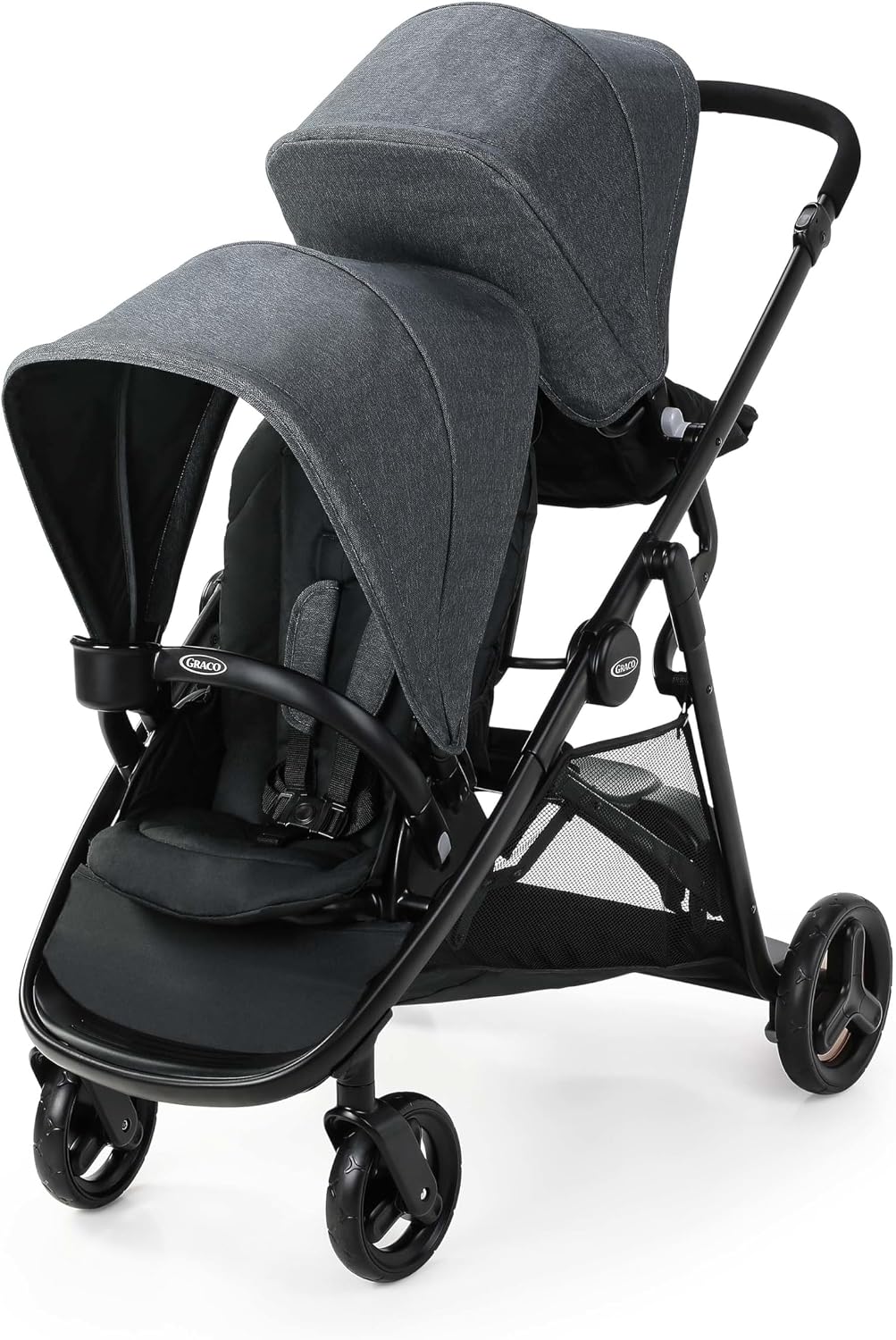
The everyday pick: Graco Ready2Grow 2.0 Double Stroller, Twin Baby Stroller Features Bench Seat and Standing Platform Options, Compact Fold Perfect for Baby Travel, Rafa
 Visit on Amazon →
This is the shape to buy when your problem is two children who both need a seat at the same time. It is a double stroller with two seats plus a bench seat and a standing platform option, which is the detail that matters if you have a baby and a preschooler rather than twins: the older kid can perch or stand for a short stretch instead of demanding a full seat. The compact fold is the other reason it shows up in this conversation, because a double that will not fold small is furniture you have to drag around, and traveling with a double is where most parents give up.
What to check when you look at it: the fold, done one-handed while you imagine holding a sleeping toddler in the other arm; the harness straps, which should lie flat and buckle without a fight; and the brake, which a 5-foot-2 parent should be able to set without looking down. Then measure your trunk before you order, because a double stroller that fits your hallway and not your car is a very expensive closet item.
Flaws but not dealbreakers: Two seats mean two seats of width. This shape is not going to feel nimble in a narrow shop aisle, and no bench-seat double is. It is a sidewalk and park machine, not a trail machine.
Check current Amazon price before you commit, and confirm the current age and weight limits for each seating position.
Parents with a baby and a toddler, or twins, who mostly push on pavement will get the most out of this one.
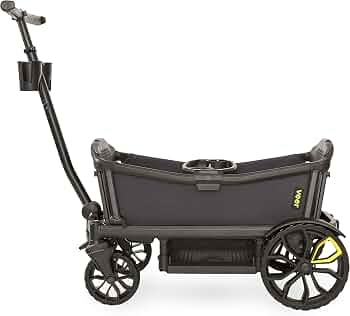
The all-terrain upgrade: Veer All-Terrain Cruiser | Premium Off-Road Wagon Stroller for Babies, Toddlers, and Kids | Push/Pull/Push-Along Steering for Uneven Terrain | JPMA Certified | Lightweight and Collapsible | 2 Seats
 Visit on Amazon →
This is the answer when the terrain is the problem, not the seating. It is an all-terrain wagon stroller with two seats and push, pull, and push-along steering, which is a genuinely different way to move kids than a stroller handlebar. The wagon form is what makes it work for a spread-out pair: kids climb in and out on their own, and the thing does not care whether your route is a gravel shoulder, a dirt path, or a lawn. It is collapsible and it is JPMA certified, both of which are on my short list of things I want to see before I recommend anything.
What to check: the steering mode you will actually use most, because push-along and pull are different skills and one of them will feel wrong to you on day one. Check the folded footprint against your trunk, since collapsible and compact are not synonyms. And check the manufacturer's minimum age and weight guidance for each seat before you put a baby in it, because wagon seating rules are not the same as stroller seating rules.
Flaws but not dealbreakers: A wagon is wider and lower than a stroller, so you will lean further and it will not thread tight doorways the way a narrow single does. It is also the premium pick in this pair. Check current Amazon price and decide whether your terrain justifies it.
Families who walk trails, gravel, or beach, or whose older kid is in and out of the seat every four minutes, should start here.
The decision workflow, step by step
Do these in order and you will not need to guess.
Step one: Count riders, not kids. Write down how many children are actually seated at the same time on a normal Tuesday. Two riders most of the time points at the double stroller. One rider plus one kid who walks, scoots, or gets carried points at the wagon.
Step two: Measure your trunk. Not the cargo volume in the brochure. Open the trunk, put a tape measure on it, and write down length, width, and height. This is trunk Tetris, and it eliminates more strollers than any other step. My 2012 Ford Fiesta has ended more shopping trips than my budget ever did.
Step three: Measure your front door and your hallway. A double that clears the sidewalk can still fight the doorway into your own house, especially with a bag on your shoulder.
Step four: Do the fold ten times in the store or in your living room. Not once. Ten. Count how many steps it takes, whether it stands on its own once folded, and whether you can do it with one hand. A fold that needs two hands and a knee is a fold you will avoid, and a stroller you avoid is a stroller you leave in the garage.
Step five: Buckle the harness and set the brake, one-handed. Straps should lie flat with no twist, the crotch buckle should not fight you, and you should be able to reach and set the brake without bending over to look at it. If you are 5-foot-2 like me, this is where a lot of otherwise good strollers fall out of the running.
Step six: Match the wheels to your actual route. If 90% of your miles are smooth pavement, you do not need off-road wheels, and you will pay for them in weight every single day. If your route has gravel, dirt, or a beach, a pavement stroller will rattle your kid awake and you will hate it by week three.
Step seven: Check cargo honestly. Where does the diaper bag go? Where does the grocery run go? A stroller whose basket is a polite suggestion is a stroller that turns you into a pack animal.
Step eight: Run the kid test. Hand it to your children for 30 minutes with no instructions. Climbing, folding, dragging, and spilling are part of the evaluation, not an interruption of it. Whatever survives that is the one you keep.
What actually decides it
If you have read this far, the honest tiebreaker is this: buy for the 80% day, not the 5% day. Most families do not need the most capable stroller on the market. They need the one that fits the trunk, the doorway, and the route they walk four times a week, and that they can fold while holding something else.
A bench-seat double stroller wins when two kids ride at once and the pavement is smooth. An all-terrain wagon wins when the ground is rough or when one kid is in and out constantly. Neither one is a compromise pick, and neither one replaces the other. Some families, honestly, end up with both: the double for errands and the wagon for weekends.
What I would not do is buy an off-road machine for a paved life, or a compact pavement stroller for a gravel life, because both of those mistakes cost money twice.
What this costs you over time
I will not quote you a price here, because prices move and I only trust the number on the screen at checkout. Both product links above will show you the current price on Amazon, and that is the number that matters.
What I can tell you is how to think about the money. Divide the price by the number of days you will actually use it. A stroller you push four times a week for three years is roughly 600 uses, and almost anything looks reasonable spread across 600 uses. A stroller you push twice because the fold annoys you is a terrible deal at any price, which is why step four above is the most important step on the list.
Then add the accessories you will actually need, which is usually fewer than the registry suggests: a rain cover for Portland, a cup holder you will lose, and a parent console if your model does not have one. Skip the rest until you have used the stroller for a month.
Buy the shape that fits your week. Fold it ten times before you decide. Measure your trunk with an actual tape measure, and let the box's weight claim go.
That is the whole decision.