There is a specific Portland afternoon that teaches you everything about a stroller. It is 52 degrees, the sidewalk on the way to the Sellwood library has a seam that has been heaving since 2019, there is a gravel shoulder where the curb cut should be, and you are holding a coffee in one hand and a sleeping three-year-old in the other. The stroller you bought because it looked good under showroom lighting has become a problem you are solving with your knee.
That is why I think of a compact travel stroller as equipment, not an accessory. The good ones disappear into your routine. The bad ones become a second job you push around.
I spent nine years as a pediatric nurse on a NICU floor before I stayed home with my three kids, and I still work per diem shifts, which means I notice small failure points for a living. I started reviewing strollers because I got tired of spec sheets that did not match what my tape measure recorded. What follows is how I would choose and set up a stroller in 2026, whether you are shopping the budget end or the upgrade end.
Why you should trust me
Every stroller I write about was bought at retail, with my own money. I have never reviewed a loaner, and no brand sees anything before it publishes. That rule costs me time and money, and it is the only reason the numbers in my spreadsheet mean anything.
My protocol is the same for every stroller I bring home. I fold and unfold it 100 times with a Casio stopwatch running, because what a fold mechanism does at fold #1 tells you almost nothing about what it does at fold #100. I push a 22-pound weighted doll over a fixed 2.1-mile route I call the Ellie loop: broken sidewalk seams, a gravel shoulder, a 1.5-inch curb-cut lip, and a rain-slick painted crosswalk. I run a one-handed push test with a 16-ounce coffee on the handlebar for 100 yards and I record the spills in ounces. I measure the folded package with a tape measure and weigh it on a luggage scale, because claimed weights and real weights are two different genres of writing.
I am past 250 logged test sessions and closing in on 110 strollers. I still keep my Oregon RN license current. And I never recommend a stroller with a recall history or a known harness problem, no matter how good the fold is.
How I picked and how I tested
This is a how-to guide, not a ranking of 40 strollers. The two picks below are here because they represent the two honest choices in this category: a compact umbrella-class stroller for travel and errands, and a convertible stroller that handles a newborn and a toddler without you buying twice.
Before anything else, I look for three cheap signals.
The first is the claimed-versus-measured weight gap. If a box claims one weight and my luggage scale records another, the build quality is usually hiding somewhere else too.
The second is the fold mechanism itself. A single-action fold degrades better than a fold that takes three separate moves. Multi-step folds are the ones that need a palm strike by fold #50.
The third is wheel behavior on the gravel shoulder of the Ellie loop. If the front wheels rattle or wander there, they will rattle on a crosswalk, in a store aisle, and in the airport.
Then comes the real-world work. I check brake reach from a natural standing position, because I am 5'2" and a brake I have to hunt for is a brake I will not use. I check harness straps for twist and I buckle and unbuckle them bare-handed. I do trunk Tetris in my 2012 Ford Fiesta, which means the folded stroller has to share space with a week of groceries and still let me close the hatch. And every survivor goes through the June gauntlet: 30 unsupervised minutes with my three-year-old folding, dragging, climbing on, and spilling on it.
The two kinds of stroller, and who each one is for
A stroller purchase goes wrong when you buy for the showroom instead of the routine. So start with the routine. If most of your trips are short, paved, and end in a small trunk, you want an umbrella-class stroller. If you are still carrying a newborn or you want one stroller to serve from birth through preschool, you want a convertible with a lie-flat mode and a reversible seat.
Here are the two I would put at the top of each list.
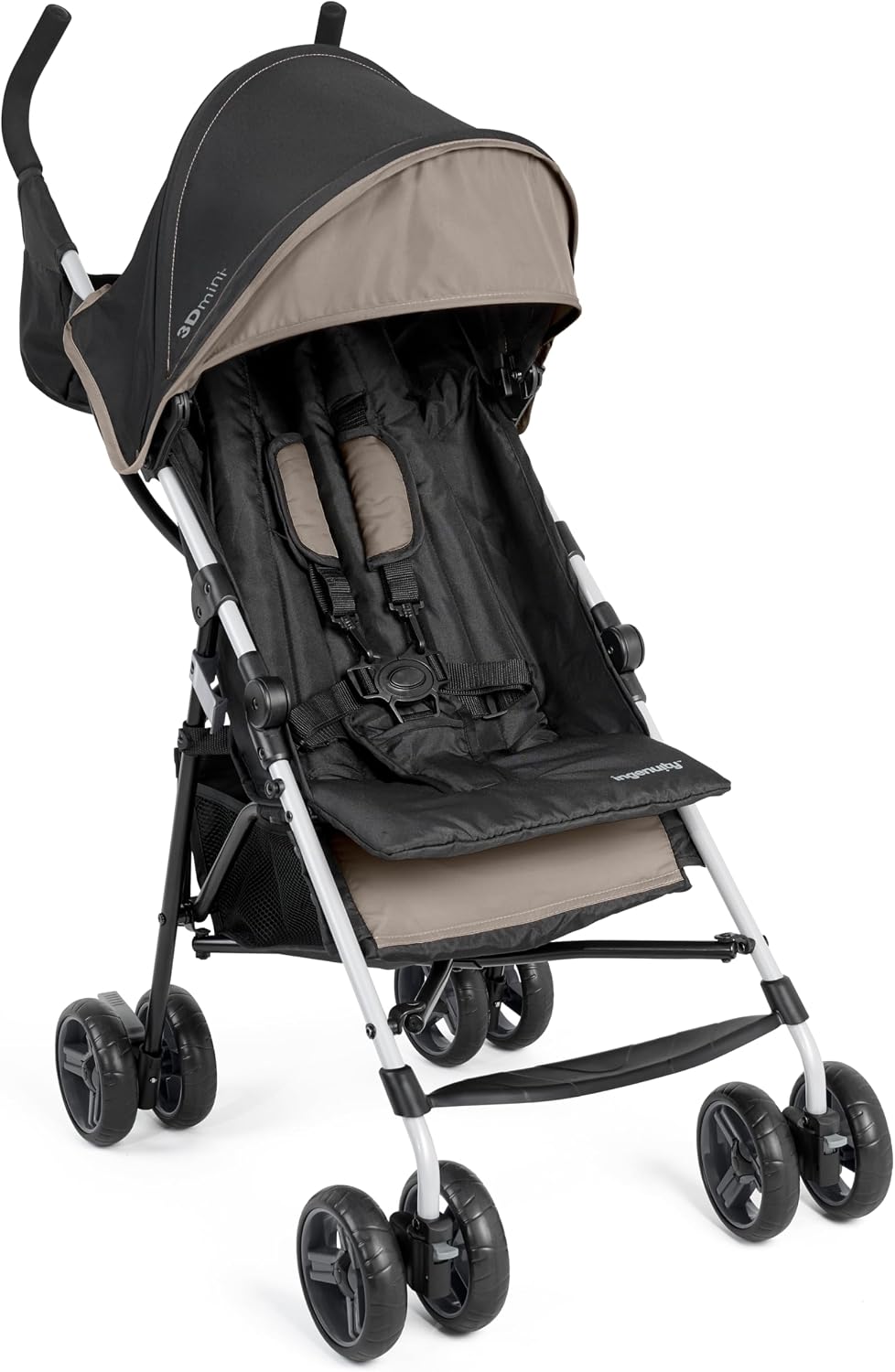
Budget pick: Ingenuity 3D Mini Convenience Stroller, Lightweight Stroller with Compact Fold, Multi-Position Recline, Canopy with Pop Out Sun Visor, Umbrella Stroller for Travel and More, Cashew Tan
 Visit on Amazon →
This is the stroller for the parent whose hatch is small and whose kid is past the infant-seat stage. The Ingenuity 3D Mini is built around three things I care about in this class. It has a compact fold, which is the entire point of owning an umbrella stroller. It has a multi-position recline instead of the single permanent sit-up angle a lot of cheap umbrellas use, and that recline is what lets a nap happen on a walk instead of in your arms. And the canopy includes a pop-out sun visor, which is the difference between a calm ride and a meltdown on a west-facing walk at six in the evening.
The Cashew Tan colorway is also the practical call if you live somewhere that salts its roads, because light fabric shows dirt as a vague haze rather than a map of every curb you have ever scraped.
Two things to verify on any umbrella-style stroller, this one included. First, whether it stands on its own when folded. It sounds minor until you are holding a sleeping toddler and the folded stroller keels over onto wet pavement. Second, wheel feel. Roll it across a rough patch before you commit, because a light stroller with hard wheels transmits every seam straight into the handlebar.
Flaws but not dealbreakers: The storage basket on this class of stroller is a polite suggestion, not a cargo hold. Plan on a backpack or a stroller hook for anything more than a jacket and a snack bag. The ride is also firm by design, because light weight and plush suspension are competing goals in a stroller this size.
Who it's for: Parents of older babies and toddlers who need something that vanishes into a small trunk, fits a bus or train aisle, and folds fast without a second set of hands.
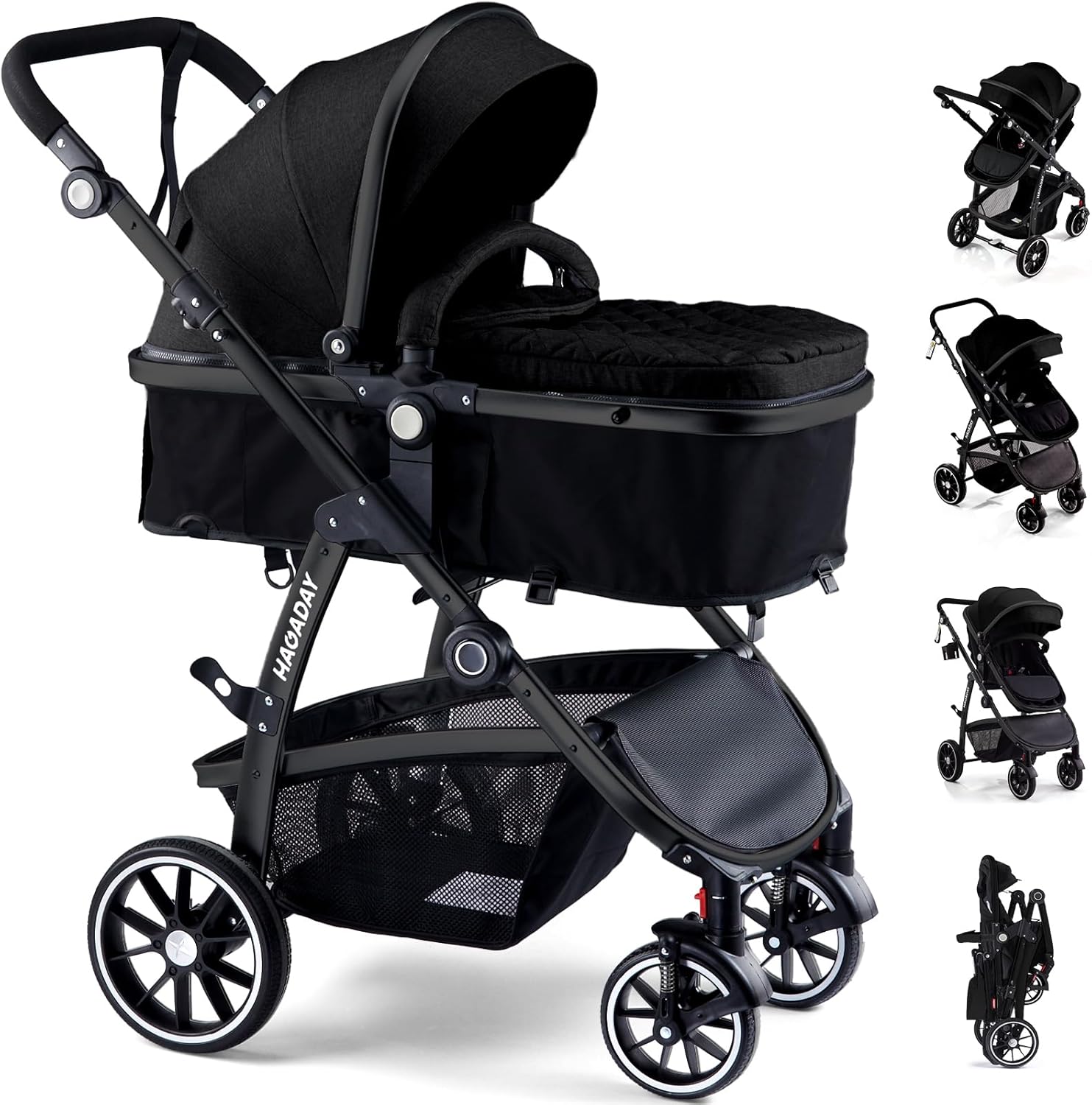
Upgrade pick: Baby Stroller, 2-in-1 Reversible Toddler Seat with Lie-Flat Mode, Foldable Infant Stroller with Canopy, One Button Brake, Adjustable Handle, Newborn Pushchair (Black B)
 Visit on Amazon →
This is the buy-once option. The 2-in-1 gives you a reversible toddler seat, which means your newborn faces you and your two-year-old faces the world, and you get that switch without buying a second seat or a bassinet. The lie-flat mode is the feature that makes it work from day one, and it is the reason I would send a first-time parent here before I sent them to an umbrella stroller.
The rest of the spec list is aimed at the things parents actually fight with. A one-button brake means you can stop the stroller with your foot while both hands are on a toddler. An adjustable handle means a 6'2" partner and a 5'2" parent can share the same stroller without either one hunching. The canopy is there for sun and light rain, which in Portland is most of the year.
Two checks before you commit. Make sure the fold is something you can do with a baby on your hip, because a convertible with a reversible seat has more parts and therefore more moves. And confirm the lie-flat surface is genuinely flat and firm, with no deep dip where the seat meets the backrest, since that is where a newborn ends up sliding.
The black colorway is the right call for a stroller that will live in a trunk and a garage, because dark fabric hides the kind of grime that never comes out of light canvas.
Flaws but not dealbreakers: Reversibility and a lie-flat mode add hardware, and hardware adds weight. This is not the stroller you sling over a shoulder for a flight. If air travel is the main use case, the umbrella-class pick above is the better tool.
Who it's for: New parents and anyone with a second baby on the way who wants one stroller to cover newborn through toddler, with a brake and a handle that work for two different adults.
The step-by-step: how to choose and set up a stroller
Now the part that saves you money. Do these in order, and do them before you order, not after the return window closes.
Step one: Measure your trunk, and measure it honestly. Open the hatch, measure the opening height, the width, and the depth of the floor. Then subtract space for a grocery run, because a folded stroller that only fits alone is furniture with wheels. Write the numbers on your phone. When you read a folded dimension on a product page, compare it to your written numbers, not to your memory of your trunk.
Step two: Decide the seat needs before the color. A newborn needs a flat recline or a newborn-approved seat. A toddler needs a seat that sits up and a footrest that supports the legs. If you are covering both, you are shopping convertibles with lie-flat modes. If your youngest is already walking, an umbrella stroller with a multi-position recline covers you for less money and less weight.
Step three: Fold it like you are tired. Then fold it nine more times. Watch for the point where the mechanism stops feeling like one motion and starts feeling like a negotiation. In my testing, the strollers that need a firm palm strike by fold #50 are the ones that fail by fold #100, and a fold that fails in a parking lot in the rain is worse than a fold that is merely slow.
Step four: Run the harness check with bare hands. Buckle it. Unbuckle it. Look at both shoulder straps for twist, and check whether the crotch buckle can be opened with one hand while the other hand holds a wriggling child. Twisted straps are the single most common thing I find on strollers that otherwise look well made, and they are also the thing you will fight at 7 a.m. every day.
Step five: Set the brake from your normal standing position. Stand behind the stroller the way you actually push it, and reach for the brake without looking down. One-button brakes are easier to trust for exactly this reason. If you have to bend or hunt, you will stop using it, and an unused brake is no brake.
Step six: Adjust the handle to the tallest person in the house. Set it for them, then reset it for you and count the moves. If sharing a stroller means a two-minute adjustment each time, you will stop adjusting it, and one of you will spend every walk hunched over the bar.
Step seven: Do the coffee-cup push on the worst surface you have. Balance a full cup on the handlebar, or hold it in one hand if the bar is not flat, and push 100 yards one-handed over broken pavement. Note how many ounces you lose and how much the front wheels wander. This is the test that separates a stroller you enjoy from one you tolerate.
Step eight: Weigh and measure the folded package yourself. Luggage scale, tape measure, no guessing. The gap between the claimed weight and the real weight is my favorite predictor of build quality, and it costs you nothing to check.
Step nine: Register the stroller and read the recall notices. Register the product so you get notified, then spend five minutes on the CPSC recall database and the manufacturer's notice page. I do not recommend strollers with a recall history or a known harness issue, and five minutes protects you from both.
What did not make the cut
Full-size convertibles lose this guide for one reason: bulk. The UPPAbaby Vista V2 folds well on the first attempt, but by fold #85 the latch needs a firm palm strike, and it is not a stroller you casually lift into a small hatch with groceries. The Chicco Bravo has a fast fold but it will not stand on its own once it is closed, which stops being a small detail the moment you are holding a sleeping toddler on wet pavement.
On the other end, the lightest umbrella strollers are a compromise in the same places every time: loud wheels on gravel, a basket that is more of a suggestion, and fabric that gives up after a year of sun. The Baby Jogger City Mini GT2 has the closest thing to a genuinely engineered one-handed fold that I have tested, and the price reflects it, so it stays a consideration rather than the default recommendation.
None of these are bad strollers. They are just answers to different questions than the one this guide asks.
What this all costs
There are two ways to spend money here, and both are legitimate.
The first is buying at the budget end and replacing sooner. An umbrella-class stroller costs less up front, weighs less, and folds smaller, but you will likely be shopping again when the fabric or the wheels give out. The Ingenuity 3D Mini sits in this tier. Check current Amazon price and do the math against how many years you actually need.
The second is buying once at the convertible tier. The 2-in-1 reversible stroller costs more up front, but it replaces a newborn stroller and a toddler stroller and a reversible seat purchase all at once. Check current Amazon price, then divide by the number of years until your youngest starts kindergarten. On a per-day basis, the expensive stroller is often the cheaper decision.
What does not cost anything is the twenty minutes of measuring, folding, buckling, and braking before you buy. That is the part that decides whether the stroller in your trunk is equipment or a problem you push. Do it once in the store or in your driveway, save the numbers, and you will not have to think about it again until you are handing it down.