Most parents buy a lightweight travel stroller in the last week before a flight, from a product photo and a weight claim. Then they stand at the gate with a boarding pass in their teeth while the thing folds into a shape that fits neither the overhead bin nor the rental car trunk. I have watched that scene play out more times than I can count, and it almost always traces back to the same mistake: nobody measured anything before they bought.
I test strollers the way I used to chart a patient. Nine years on a NICU floor taught me to notice the small failure points before they become big ones, and a stroller that jams on fold #47 is the same kind of problem as a pump that alarms at shift change. It works until it doesn't, and it fails at the worst possible moment.
The fix is not a more expensive stroller. It is a 40-minute routine you can run in your own driveway with a tape measure, a luggage scale, and a stopwatch. Below is that routine, step by step, plus the two compact travel strollers I would start with if you want a shortcut.
Why you should trust me
I spent nine years as a pediatric nurse on a NICU floor before I stayed home with my three kids. I still keep my Oregon RN license current and work per-diem shifts, which is why my stroller notes read less like a blog and more like a chart: harness strap twist, brake reach for a 5'2" parent, pinch points, and what happens on fold #47 rather than fold #1.
Every stroller I write about is bought at retail, with my own money. No free loaners, no press samples, and no brand gets to see a review before it publishes. My numbers come from a Casio stopwatch, a tape measure I trust more than any spec sheet, and a luggage scale that has caught more optimistic weight claims than I can list. I keep a spreadsheet I call the stroller graveyard, and it is past 250 logged test sessions and closing in on 110 strollers.
I also read recall notices the way other people read bedtime stories. If a stroller has a recall history or a known harness issue, it does not appear here, no matter how good the fold feels in a showroom. I do not test car seats beyond basic stroller compatibility either. That is a different expert's job.
How I picked and how I tested
The protocol is the same for every stroller that comes through my garage, and it does not care what the box promised.
Fold and unfold it 100 times with a stopwatch running. Fold #1 tells you what the engineer designed. Fold #100 tells you what you will actually live with on a Tuesday in month two.
Push a 22-pound weighted doll over the Ellie loop, my fixed 2.1-mile route through Sellwood: broken sidewalk seams, a gravel shoulder, a 1.5-inch curb-cut lip, and a rain-slick painted crosswalk. Wheels that rattle on the gravel shoulder rarely survive the winter.
Measure the folded footprint with a tape measure, then try to fit it into my 2012 Ford Fiesta alongside a week of groceries. I call that trunk Tetris, and a stroller fails if it cannot share the space.
Weigh it on a luggage scale and compare that number to the claimed weight. The size of that gap is my best cheap predictor of build quality.
Balance a 16-ounce coffee cup on the handlebar and push 100 yards one-handed. Spills get recorded in ounces, because that is what actually happens when you are holding a latte and a toddler.
Then the June gauntlet: thirty unsupervised minutes where my three-year-old folds it, drags it, climbs on it, and spills something on it. Survivors get marked toddler-proof.
Both of the strollers below are built for the travel version of that checklist: folded size against a standard overhead bin, a fold you can manage one-handed while holding a child, and a frame that can be handed to a gate agent. They are the two I point travel-heavy parents to first.
The travel strollers worth starting with
A travel stroller is not a smaller version of your everyday stroller. It is a different tool with a different job: fold small, carry light, survive a gate check, and get out of your way in an airport bathroom. You can add one to your lineup without replacing the full-size stroller in the garage.
The two below are both compact-fold designs, but they are not identical, and the difference matters depending on how you travel.
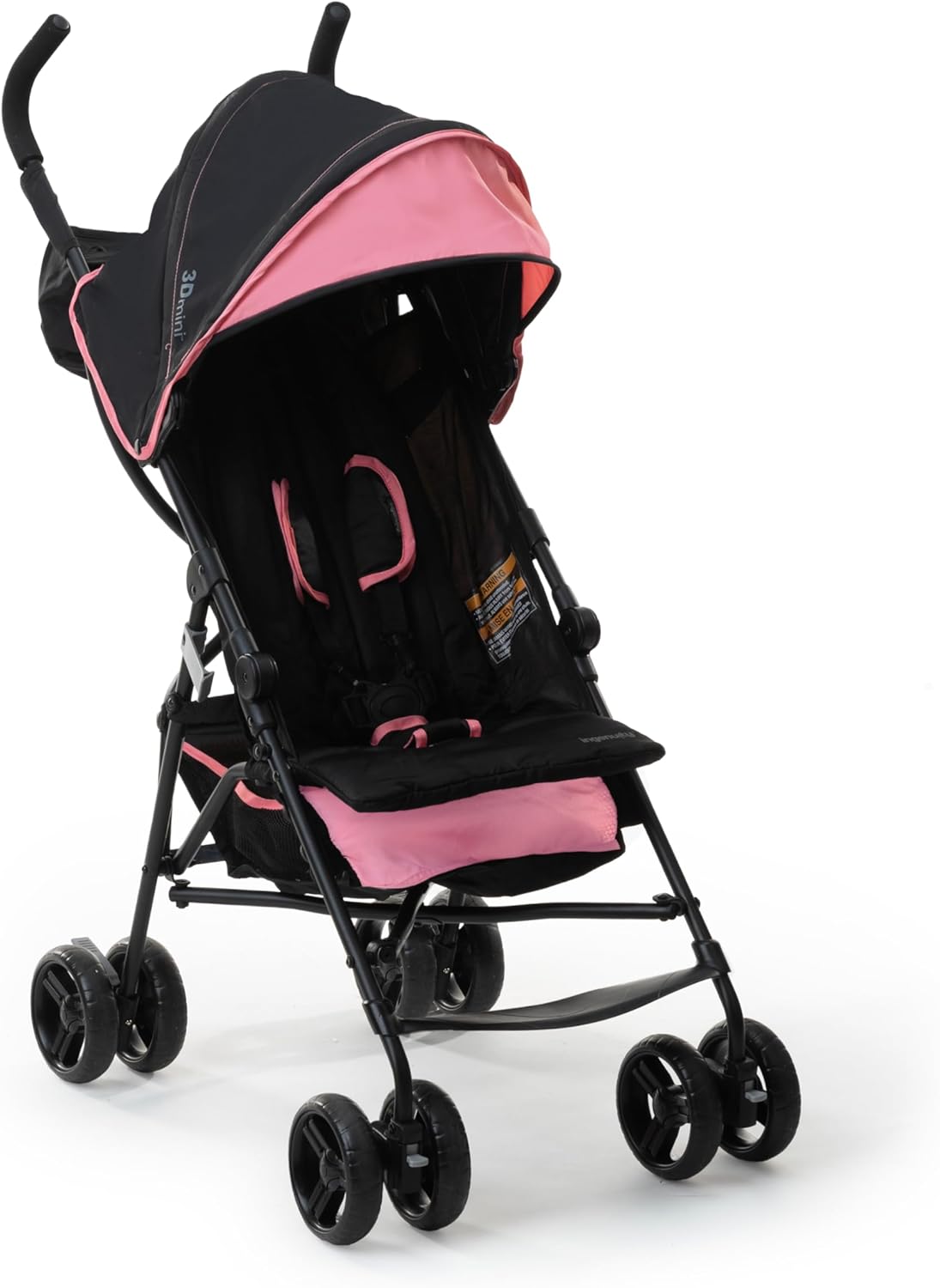
Budget pick: Ingenuity 3D Mini Convenience Stroller, Lightweight Stroller with Compact Fold, Multi-Position Recline, Canopy with Pop Out Sun Visor and More, Umbrella Stroller for Travel, Pink
 Visit on Amazon →
The 3D Mini is the umbrella-style option here, and the feature list is the reason it stays on my short list: a compact fold, a multi-position recline, and a canopy with a pop-out sun visor. That visor sounds like a small thing until you are standing at a bus stop in Portland in July with the sun coming in at exactly the wrong angle. The recline is the other feature I care about, because a stroller that only sits upright is a stroller a toddler will fight at nap time.
Flaws but not dealbreakers: Umbrella-style frames in this class often will not stand on their own when folded, which is my single biggest pet peeve in the category. Test that in your hallway before you commit, because it matters the moment you are holding a sleeping toddler in one arm. Check the basket volume with your actual diaper bag too, not with a mental image of it.
Anyone who wants a light second stroller for errands, short trips, and the trunk of a small car will get the most out of this one.
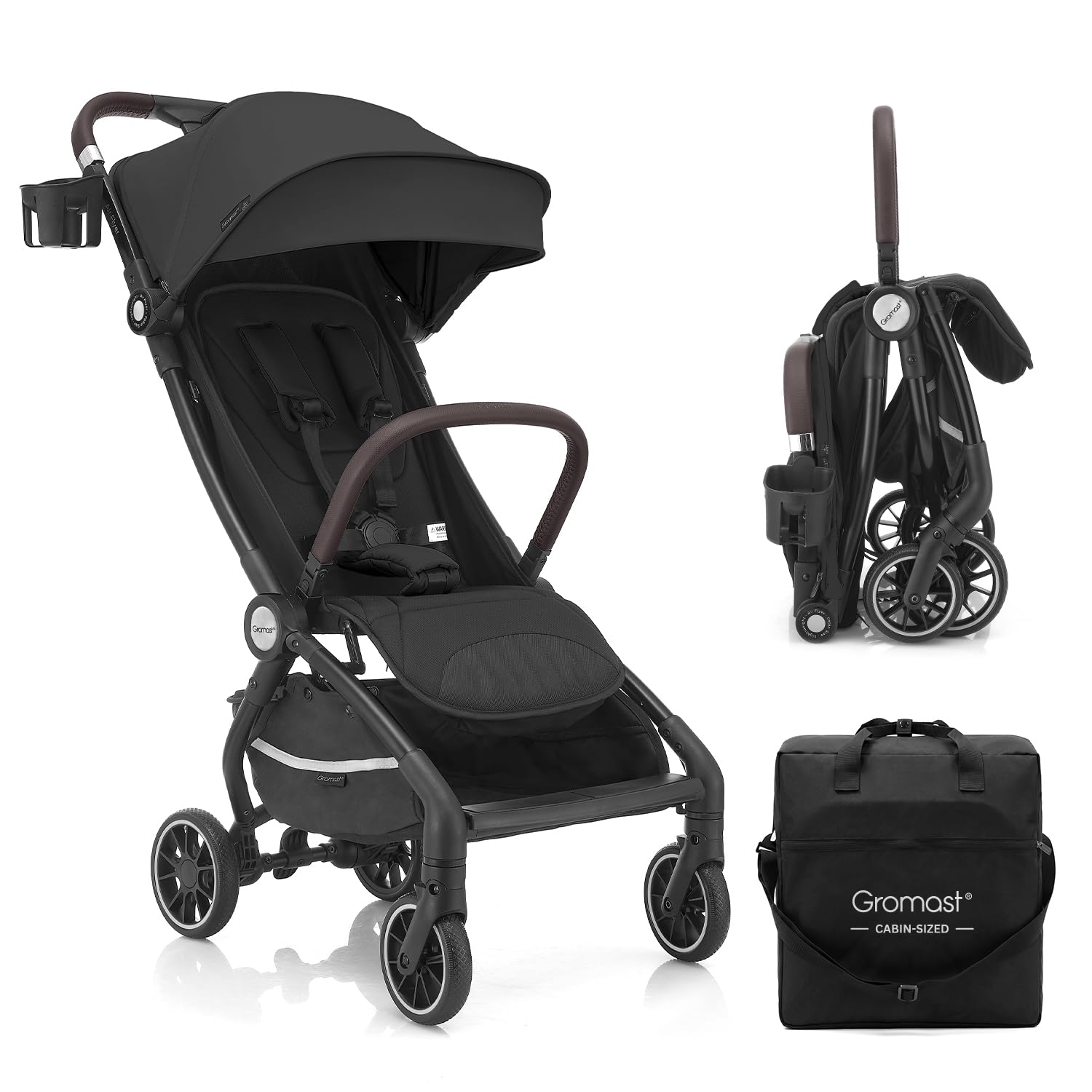
Our pick: Gromast Gravity Folding Airplane Friendly Travel Stroller for Toddlers, Lightweight & Compact Baby Stroller, Gate Check Approved, UPF 50+ Waterproof, Includes Travel Bag - Black
 Visit on Amazon →
The Gromast is the one I would hand to a parent who flies more than once a year. The name is a mouthful, but it describes the design: a gravity fold, which means the frame collapses under its own weight when you release it rather than requiring two hands and a firm shove. It is listed as gate check approved, the canopy is UPF 50+ and waterproof, and it ships with a travel bag, which is one less thing to buy before a trip.
For a lightweight travel stroller, the travel bag matters more than it sounds. A bag protects the frame from the belt loader and gives the gate agent something obvious to tag. UPF 50+ and a waterproof canopy are the two specs I actually verify in Portland, where a sunny morning turns into a wet afternoon while you are three blocks from the car.
Flaws but not dealbreakers: Gate check approved does not mean overhead bin guaranteed. Bin dimensions vary by aircraft, and a regional jet is not a 737. Measure your airline's published carry-on size and compare it to the folded footprint before you plan on keeping it with you. Also confirm that the travel bag does not push the folded package past the size you measured, because a bag adds bulk even when it adds protection.
Anyone who travels by air regularly and wants one stroller that handles the airport, the rental car, and a week of sightseeing will get the most out of this one.
The routine: how to choose and fly with a travel stroller
Now the part you came for. This works on any compact stroller, and it takes about 40 minutes at home plus a little planning before you book.
Step one: Measure your trunk first. Not the showroom, not the spec sheet, your trunk. Fold the stroller, put it in, and then put a week of groceries in next to it. If it cannot share the space, it is not a travel stroller for your car, it is furniture you have to drag around.
Step two: Look up your airline's carry-on dimensions. Overhead bins differ by aircraft, and the answer can change with the plane. Know the published number, then compare it to your measured folded size, not the claimed one.
Step three: Weigh it on a luggage scale. Spec-sheet fiction is real, and the gap between claimed and measured weight is my best cheap predictor of build quality. A stroller that fudges its weight usually fudges other things.
Step four: Run the 100-fold test in your hallway. Stopwatch optional, patience required. Note how it feels at fold 20 and fold 80. A fold that needs a palm strike by fold 50 will need a palm strike every time by month three.
Step five: Fold it one-handed while holding something heavy in the other arm. A weighted bag works. A sleeping toddler is the real test. If you cannot do it with one hand, you cannot do it at a jet bridge with a boarding pass in your teeth.
Step six: Check the harness with one hand. Look for strap twist, then buckle and unbuckle the crotch buckle a few times without looking. Harnesses that fight you one-handed are the most common complaint I hear from parents, and it is a fixable problem if you catch it before the return window closes.
Step seven: Check the brake with your foot while holding the handlebar. A brake you have to look down to find is a brake you will not use on a sloped crosswalk in the rain.
Step eight: Do the coffee-cup push. Balance a full cup on the handlebar and push 100 yards one-handed. Whatever you spill is what you will spill on a real sidewalk.
Step nine: Hand it to a toddler for 30 minutes. Let them climb on it, fold it, drag it, and spill on it. Survivors earn the label toddler-proof. This is the step most parents skip and the one that predicts the most.
Step ten: Decide gate check versus bin before you reach the jet bridge. If the stroller goes in the bin, it needs to be folded, light, and small enough that you are not holding up the boarding line. If it goes to the gate, the travel bag protects it and makes it obvious to the agent. Know which one you are doing before you are standing in the aisle.
Step eleven: Inspect it after every flight. Open the frame, spin the wheels, work the latch, and check the canopy struts. A bent frame or a wobbly wheel is easier to catch at baggage claim than three days into a trip.
The competition and why it lost
A few categories show up in my inbox constantly, and they are not wrong, they are just not this.
Full-size convertible strollers with big baskets and huge canopies are wonderful on the Ellie loop and miserable at a gate. If you already own one, keep it. A lightweight travel stroller is the second tool, not a replacement.
Double strollers solve a different problem. If you have two kids in seats, your bin math changes completely, and you should plan on gate checking rather than trying to carry it on.
Jogging strollers are built for speed and suspension, not for folding small. Great on gravel, terrible in a trunk.
The cheapest umbrella strollers, the ones that cost less than a pizza night, usually lose on the same three things: no recline, a canopy that barely covers a face, and a frame that will not stand when folded. If you only need something for the walk to the mailbox, fine. If you are getting on a plane, spend once.
One more category that does not belong in this conversation: car seats. I do not test them beyond basic compatibility, and neither should a stroller guide. Talk to a certified technician for that.
What this all costs
Here is the honest math. The stroller is the small part. The travel bag, the gate-check tag, the rental car trunk that is smaller than you expected, and the replacement stroller you buy at your destination after the cheap one breaks are the expensive parts.
Check current Amazon price on the Ingenuity 3D Mini if you want the lighter spend for errands and short trips. Check current Amazon price on the Gromast if you fly and want the gravity fold, the gate check approval, and the included travel bag in one purchase.
Then divide that number by the trips you actually take in the next three years. That is the number that matters, not the sticker. A stroller that survives 100 folds and three gate checks costs less per trip than one that breaks on the second flight, even when it costs more on the day you buy it.
Do the routine once in your driveway. Measure the trunk, weigh the frame, fold it 100 times, and let a three-year-old abuse it for half an hour. Then you will know, before you spend anything, whether the stroller in your cart is a travel stroller or a piece of furniture with a canopy.