Most parents buy a stroller the way they buy a couch: they sit in it once, on carpet, in good lighting, and call it a decision. Then the baby arrives, the carpet turns into a cracked sidewalk, and the couch metaphor falls apart. I have watched this happen in my own driveway three times.
Here is what I tell every parent who asks me which stroller to buy: the stroller is not the product. The fold is the product. A lightweight travel stroller that folds fast and fits beside a week of groceries gets used every single day. A heavier stroller with a beautiful canopy that eats your whole trunk stays in the garage and becomes a shelf.
So this is not a list of the "best" strollers. It is a method for deciding which one belongs in your car, worked through two very different examples: a carbon fiber travel stroller for one kid, and a side-by-side double for two.
Why you should trust me
I'm Maggie Knoll. I spent nine years as a pediatric nurse on a NICU floor before I stayed home with my three kids, and I still keep my Oregon RN license current and work per-diem shifts. That background is why my stroller notes read like a chart: harness strap-twist, brake reach for a 5'2" parent, pinch points, and what happens on fold #100 instead of fold #1.
I buy every stroller at retail. No loaners, no press samples, and no brand sees a review before it publishes. I also won't recommend anything with a recall history or a known harness problem, no matter how good the fold feels in the first five minutes.
How I picked and how I tested
Both strollers below are here because they solve a specific problem well, not because they cost the most.
Everything that comes through my house runs the same protocol. I fold and unfold it 100 times with a Casio stopwatch running, because the mechanism you get at fold #1 is not the mechanism you live with at fold #100. I push a 22-pound weighted doll around the Ellie loop, my fixed 2.1-mile route that covers broken sidewalk seams, a gravel shoulder, a 1.5-inch curb-cut lip, and a rain-slick painted crosswalk. I do the coffee-cup push, one hand on the handlebar with a 16-ounce cup balanced on top, for 100 yards. Then June, who is three, gets 30 unsupervised minutes to fold, drag, climb on, and spill on it. Survivors get marked toddler-proof.
The numbers I trust come from a tape measure and a luggage scale, not a spec sheet. Claimed folded dimensions are a starting point. The tape measure is the verdict, and if the box says one thing and my scale says another, I trust the scale and I say so out loud.
The two strollers worth starting with
I'm giving you two because the right answer depends on how many kids you're moving and how much trunk you have. Read both before you pick, because the second one is not a bigger version of the first.
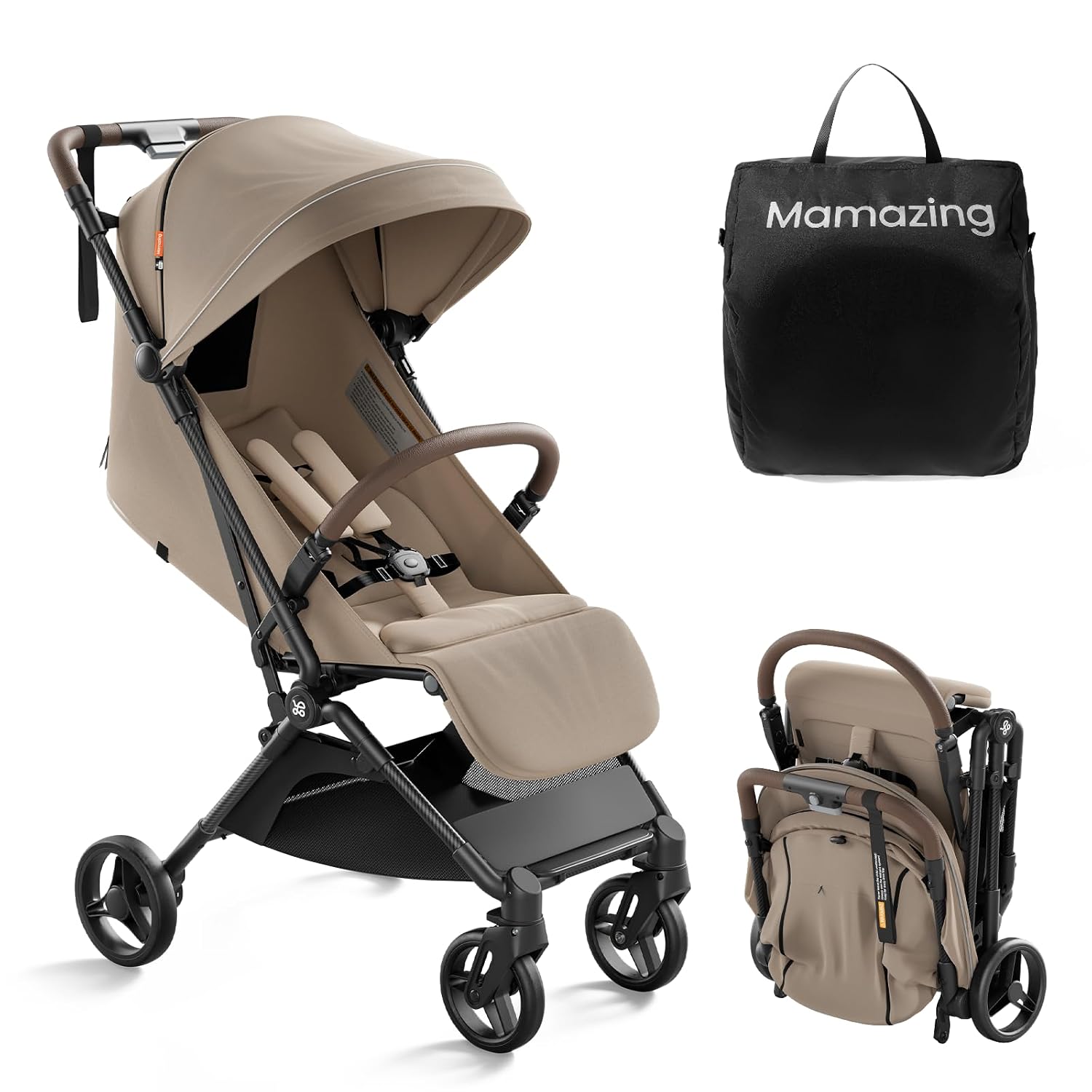
The small-trunk pick: Mamazing Ultra Air Lightweight Baby Travel Stroller with Carbon Fiber Frame
 Visit on Amazon →
This is the stroller I hand to parents who drive a compact car and fly more than once a year. The carbon fiber frame is the headline, and it is the reason this one sits in the travel category rather than the everyday category: carbon fiber is doing the work that steel and aluminum usually do, which is what makes a one-handed carry up a jet bridge realistic instead of aspirational.
What I care about more than the frame material is the fold, because a travel stroller lives or dies there. Fold it once, then fold it 99 more times. If the latch still catches cleanly and the frame doesn't flex when you set it down, you have a stroller that will survive a toddler. If it needs a palm strike by fold 50, you don't.
The caveats are the usual travel-stroller caveats, and I want you to go in with your eyes open. This is a one-child stroller, full stop. Before you buy, check the basket against your actual daily load, because a diaper bag and a jacket is a different ask than a grocery run. Check the wheel type against your terrain: pavement, airport tile, and packed gravel are this category's home turf, not a muddy trail. And if you're used to a full-size stroller's recline and canopy, a travel stroller will feel like a compromise on day one and completely normal by the second week.
Parents who fly, ride transit, or park in a small garage will get the most out of it. Parents who need a bassinet setup or a two-kid ride should keep reading.
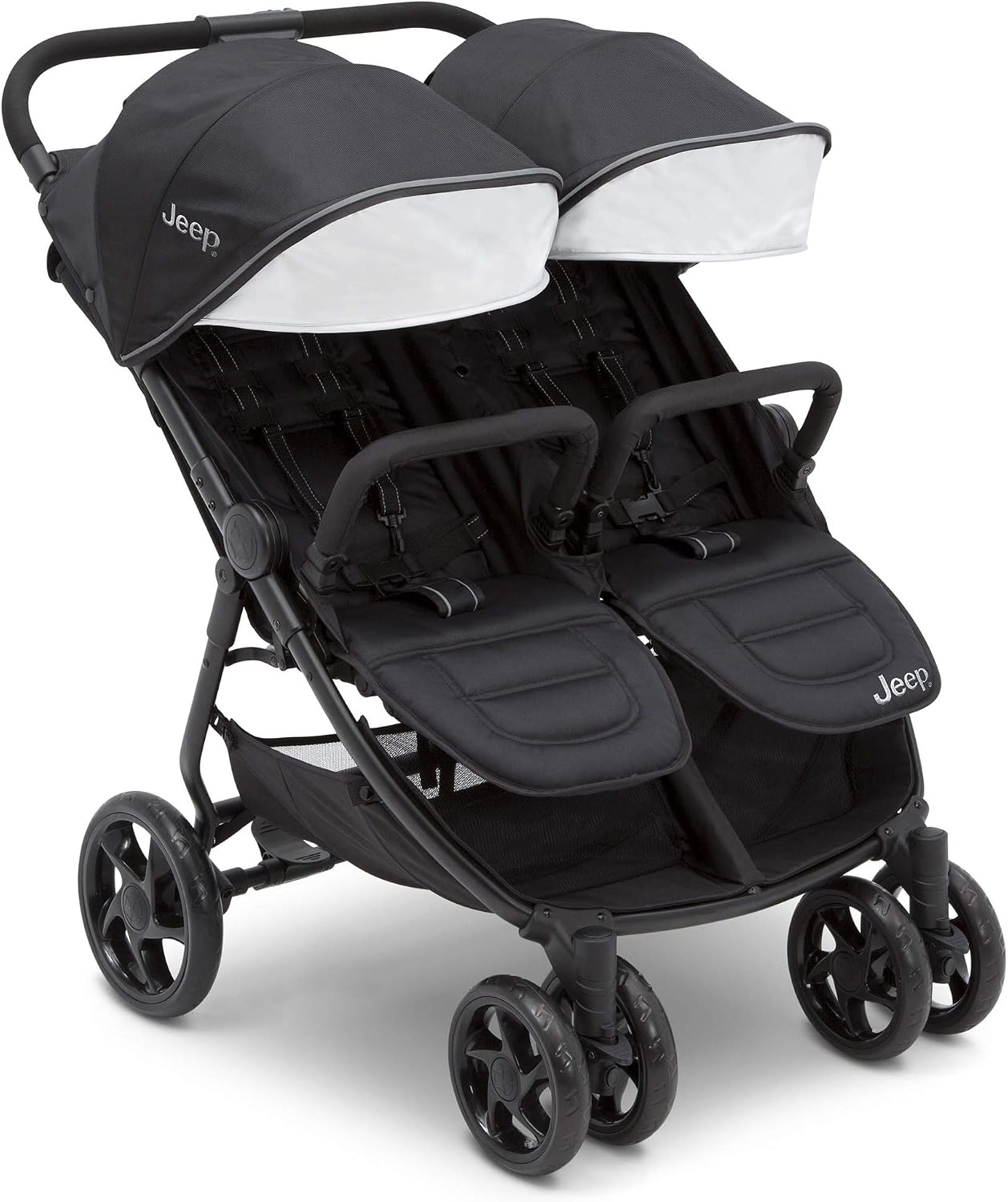
The two-kid pick: Jeep Destination Ultralight Side x Side Double Stroller, Midnight
 Visit on Amazon →
A side-by-side double is a different animal. It is not a travel stroller and it will not fold into an overhead bin, but it is the honest answer for two kids close in age who both still want to ride. "Ultralight" in the name is doing real work here, because the alternative in the double category is a stroller heavy enough that you start dreading the loading part before you've even left the driveway.
Side-by-side doubles come with one unavoidable tradeoff: width. Before you buy any of them, measure the narrowest door in your house, the waiting room at your pediatrician, and your favorite coffee shop. Then measure the folded package and measure your trunk. This is trunk Tetris, and it is the step people skip because the showroom floor is wide open.
What matters in this category is that each seat works on its own schedule, because one kid will want to nap while the other wants to point at a dog. Verify that on the listing before you commit, along with the seat-back recline and the harness adjustability on both sides, since the second seat is usually where manufacturers cut corners.
Flaws but not dealbreakers: it's a wide stroller, and wide means some doorways and crowded sidewalks are a two-person negotiation. It's also not the stroller you take on a plane. This is the neighborhood and errand stroller. The travel stroller above is the one that goes in the overhead bin.
How to choose in seven steps
Now the part you came for. This works whether you're standing in a store or staring at a listing at 11 p.m.
Step one: measure your trunk before you measure anything else. Width, depth, and the height of the opening. Then check the trunk lip, because a stroller can fit in the floor of the trunk and still not clear the lip on the way in. Write the three numbers on your phone. Every folded-dimension spec you read after this gets compared to those numbers, not to a photo of a stroller in a spotless cargo area.
Step two: decide how many kids you are moving right now. Not in two years. Right now. If you have one baby and no second on the way, a double is 15 pounds of stroller you fold for no reason, and it will make you hate every errand. If you have twins or an infant and a toddler, a single stroller plus a buggy board is a compromise you will feel in your wrists.
Step three: fold it ten times in a row, one-handed, before you commit. You will fold this stroller while holding a baby, a coffee, or a car key, so practice the way you'll actually live. If your hand needs a second grip point or a firm palm strike on the tenth fold, imagine fold 100.
Step four: put your bare hands on the harness. Run your fingers down both straps looking for twist, which is the most common failure I find. Buckle and unbuckle the crotch buckle one-handed, because that's the buckle that fights you in a parking lot in the rain. Check where the shoulder straps sit on a small torso and whether the adjusters stay where you put them.
Step five: check brake reach from your normal stance. Stand behind the stroller the way you push it, not the way a showroom makes you stand. A rear brake that requires a toe stretch is a real safety problem on a Portland hill, especially with a 22-pound kid plus groceries on board.
Step six: walk your own route, not the store's. Take it over the broken sidewalk seam at the end of your block, the gravel shoulder by the park, and the painted crosswalk that gets slick in the rain. Wheel noise on gravel is the tell. If it rattles on packed gravel, it will rattle on everything.
Step seven: weigh it yourself if you can. A luggage scale costs less than lunch and it settles arguments permanently. Then ask the real question: would I carry this up a flight of stairs, or lift it into an SUV, while a toddler is attached to my leg? If the answer is no, the weight is wrong for your life, no matter what the box claims.
Where each one stops working
The Mamazing travel stroller stops working the moment you need a second seat, real cargo space, or a stroller that handles a muddy trail. That is not a defect; it's the trade you made for a small fold and a light frame. If you buy it expecting full-size comfort, you'll be disappointed by week two.
The Jeep side-by-side stops working in narrow doorways, on airplanes, and in small trunks. Wide is the price of two seats, and it is not a negotiable price.
The useful thing about naming those limits is that you stop shopping for one perfect stroller and start shopping for the one that fits the next two years of your actual routine. For a lot of families that means two strollers: a compact one for travel and errands, and a double for the neighborhood. That's not indulgence. That's matching the tool to the job.
What this all costs
Take the price of either stroller, whatever it says today (check current Amazon price on each listing, because this tier moves), and divide it by the number of days you'll realistically use it. If you use a stroller five days a week for two years, that's about 500 uses. Divide by 500 and almost anything in this category looks reasonable. Divide by 12, which is what happens when the stroller is too bulky to bother with, and even a cheap stroller is expensive.
That math is the argument for measuring your trunk first. The stroller that gets used is the cheap stroller, regardless of what you paid for it. The stroller that lives in the garage is the expensive one.
If you fly, price out what an airport stroller rental costs for a single trip. For frequent travelers, the travel stroller pays for itself fast, and the carbon fiber frame is what keeps it carry-able.
The bottom line
Measure your trunk. Count your kids. Fold the stroller ten times before you fall in love with it. Pick the one that survives fold #100, fits behind the groceries, and doesn't make you dread the walk to the car.
Your kid doesn't care what you spent. They care whether the ride is smooth and whether the harness fits. Get those two right and the rest is just trunk Tetris.