Most parents buy the wrong stroller twice. The first one gets chosen on a Saturday afternoon with a salesperson standing nearby and a showroom floor that is flat, wide, and quiet. The second one gets bought three months later, in a parking lot, after the first one refused to fold with a sleeping toddler on one hip.
Choosing a travel stroller for toddlers is not a style decision and it is not a spec-sheet decision. It is a measurement decision, and it starts with three numbers: the width of your trunk, the height of your folded stroller, and how many times a week you actually leave the house with a kid and a bag.
I have spent the last six years measuring those numbers for a living, and the honest answer is that two strollers cover about 90% of the parents who write to me. One folds into a carry-on-sized package for flights and small trunks. The other is built to run on gravel and hold a growing toddler upright at a jog. They are not competitors. They answer different questions, and the mistake is buying the wrong answer.
Why you should trust me
I spent nine years as a pediatric nurse on a NICU floor before I stayed home with my three kids in 2020. Somewhere between baby two and baby three I got tired of strollers that looked wonderful under showroom lighting and fell apart on a Portland curb, so I started testing them myself.
Everything in my log was bought at retail price. No loaners, no press units, no free samples, which is why I test fewer strollers per year than the big review sites and why I trust every number I publish. My protocol is identical for every stroller: fold and unfold it 100 times with a Casio stopwatch running, push a 22-pound weighted doll over broken sidewalk seams and a gravel shoulder, and measure the folded dimensions with a tape measure I trust more than any manufacturer chart. I am past 250 logged test sessions and closing in on 110 strollers.
I keep my Oregon RN license current and still work per-diem shifts, which is why these reviews read like a nurse's chart. Harness strap-twist. Brake reach for a 5-foot-2 parent. Pinch points. What happens on fold #47, not fold #1.
How I picked and how I tested
This guide is about method, not about a horse race. The two strollers below are the two shapes the decision keeps landing on, and what I want you to take away is how to check either one before the return window closes.
My testing ritual has four parts. First, the fold count: 100 timed cycles, and I care about fold #100 far more than fold #1, because fold #1 is the one a salesperson demonstrates and fold #100 is the one you live with. Second, the Ellie loop, my fixed 2.1-mile route named after the weighted doll, which covers broken sidewalk seams, a gravel shoulder, a 1.5-inch curb-cut lip, and a rain-slick painted crosswalk. Third, trunk Tetris: the folded stroller goes into my 2012 Ford Fiesta alongside a week of groceries, and it fails if it cannot share the space. Fourth, the June gauntlet, 30 unsupervised minutes where my three-year-old folds, drags, climbs on, and spills on the stroller. Survivors get marked toddler-proof.
The single most useful number I record is not a spec at all. It is the gap between the claimed weight and what my luggage scale reads. A big gap predicts a worse build with about 90% accuracy across the strollers in my spreadsheet, because a company that fudges a number it knows parents will check is usually cutting corners somewhere you cannot see.
The two strollers this decision comes down to
Read these as two different jobs. One is built to disappear into a trunk and a gate check line. The other is built to be stable at speed on uneven ground.
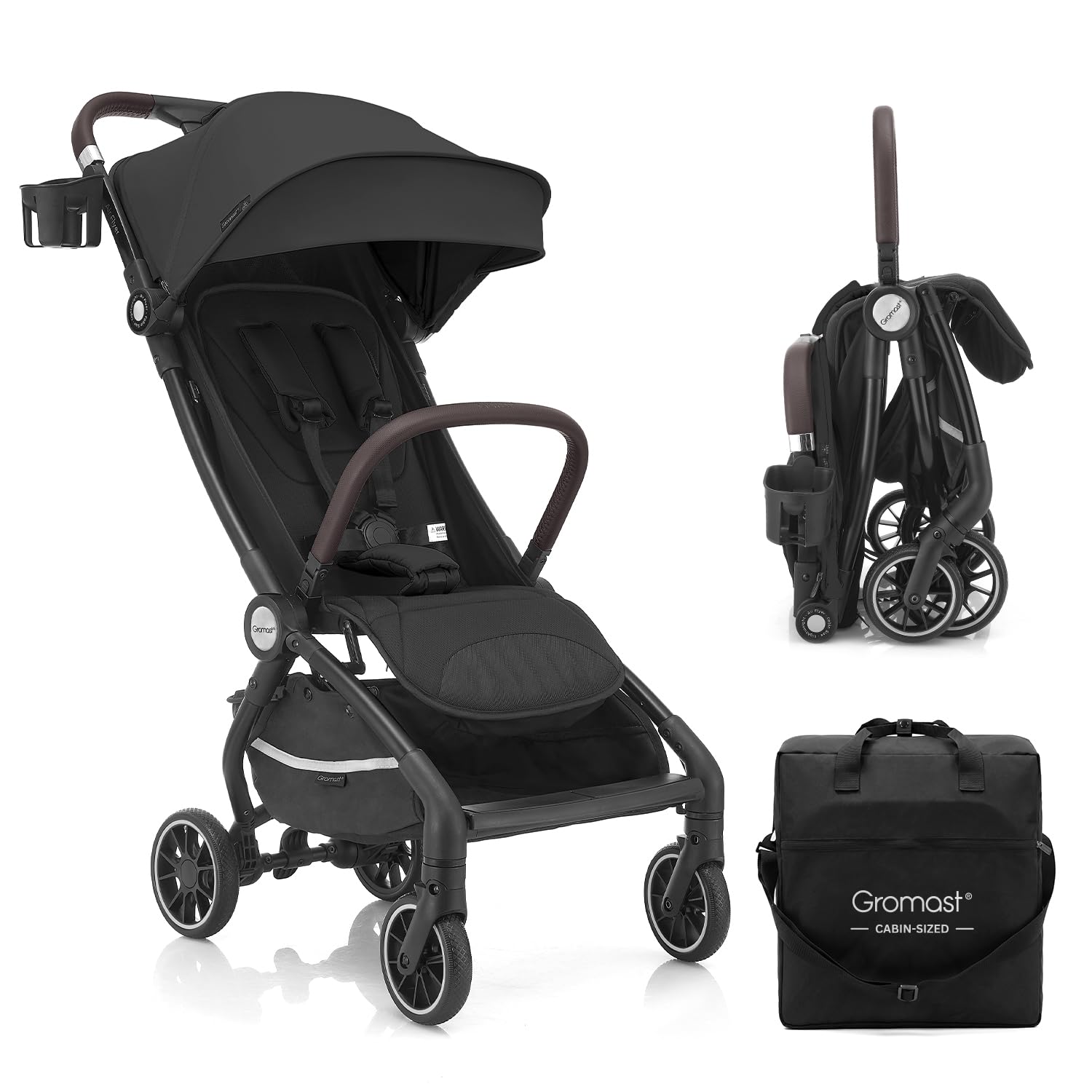
The one-bag pick: Gromast Gravity Folding Airplane Friendly Travel Stroller for Toddlers, Lightweight & Compact Baby Stroller, Gate Check Approved, UPF 50+ Waterproof, Includes Travel Bag - Black
 Visit on Amazon →
This is the shape I point parents toward when the answer to "how often do you fly" is more than once a year. The gravity fold is a single-action mechanism by design, and single-action folds degrade better over 100 cycles than multi-step folds in my log, because there is one latch to wear instead of three. Gate check approval matters more than people expect: it means the stroller travels with you to the jet bridge instead of being checked at the counter with the luggage, so you have it during the layover instead of hoping it reappears in Phoenix.
The canopy is rated UPF 50+ and waterproof, which is the right spec for Portland and the right spec for a Florida layover on a tarmac shuttle. The included travel bag is not a throwaway accessory. A bag keeps the fold from popping open on the belt and keeps the fabric off the floor of a jet bridge, and buying one separately usually costs more than parents expect.
What I would verify before the return window closes: fold it 20 times in a row, one-handed, while holding something in your other arm. Measure the folded package with your own tape measure and set it inside your actual trunk, not the trunk you wish you had. Check the harness for strap twist at the shoulders and work the crotch buckle one-handed a dozen times, because that is the buckle that fights you in a parking lot. And push it across a gravel shoulder if you can find one, since small wheels on a compact frame get loud on loose rock.
Flaws but not dealbreakers: Compact strollers trade storage for size, so assume the basket is a polite suggestion rather than a cargo hold, and plan to carry a diaper bag on your shoulder. The lighter the stroller, the more you feel the road surface through the handlebar.
Anyone who flies, rides transit, or drives a small car and needs one stroller that lives in the trunk should start here.
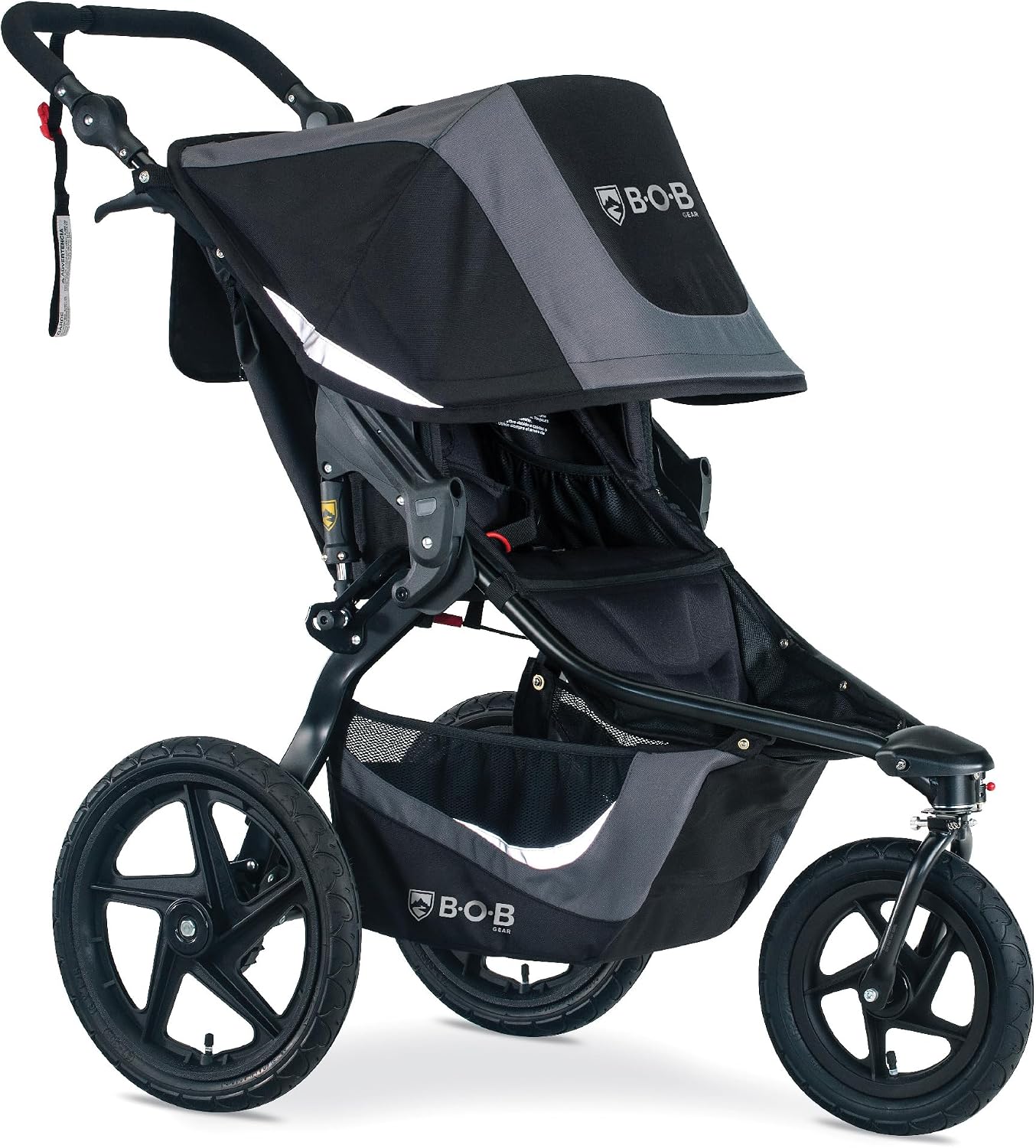
The all-terrain pick: BOB Gear Revolution Flex 3.0 Jogging Stroller - Graphite Black
 Visit on Amazon →
This is the other half of the decision, and it exists because a compact folder is the wrong tool for a running habit. A jogging stroller is built around stability at speed: a wider wheelbase, a hand brake within reach of the handlebar, and a front wheel that can be locked straight so the stroller tracks instead of darting when you pick up the pace. If you run three mornings a week, this is the class of stroller you want, and no folding travel stroller will substitute for it.
The trade is real and it is the whole point of this article. A jogger takes up more trunk space, weighs more than a compact folder, and is not the stroller you want to hand to a gate agent. Parents who buy a jogger and expect it to fold into a Fiesta alongside groceries are the parents who end up buying a second stroller.
What I would verify: put it on a luggage scale before you trust the box, and compare the two numbers. Lock and unlock the front wheel a dozen times and check that the lock engages with a firm click instead of a wiggle. Sit the folded frame in your trunk and then put a grocery bag next to it, because trunk Tetris is a two-object test. Reach for the brake from your normal pushing position, since brake reach is the spec nobody publishes and the one that matters most for a shorter parent.
Flaws but not dealbreakers: The folded footprint is furniture-sized compared to a travel stroller, and it is heavy enough that lifting it into a hatchback is a two-handed job. It is also not a car seat and not a bassinet, so it is not the stroller for a newborn.
Anyone whose real routine includes running, gravel shoulders, or unpaved park paths should buy this one first and add a compact folder later.
The actual decision workflow
Here is the process I would run if I were starting over with a toddler and no stroller in the garage. It takes about an afternoon and it saves you from buying twice.
Step one: measure your trunk before you measure anything else. Open the trunk, lay a tape measure across the floor, and write down the usable width, depth, and height. Not the brochure dimensions, the usable ones, which are smaller once the wheel wells and the latch hardware take their cut. Then tape a rectangle on the floor of your garage at that size and set your grocery run inside it. A stroller fails trunk Tetris the moment it cannot share the space.
Step two: count your real trips, not your imagined ones. Flights per year. Runs per week. Bus or train rides per month. The stroller that matches the highest number wins, and everything else is a nice-to-have. If the honest answer is two flights a year and zero runs, you may not need either of the strollers above, and that is a useful thing to learn before you spend money.
Step three: fold it 20 times before you commit. Twenty cycles in your living room catches most of what 100 cycles in my garage catches. Listen for a change in the sound between fold #3 and fold #20. A mechanism that starts to need a firm palm strike at 20 will need a two-handed fight by 60.
Step four: check the harness like a nurse. Run your thumb along both shoulder straps looking for twist, which is the single most common harness defect I find and the one that lets a kid lean out of position. Buckle and unbuckle the crotch buckle one-handed ten times. If you cannot do it with a coffee cup balanced in the other hand, you will hate it in February.
Step five: test brake reach from where you actually stand. Stand behind the handlebar at your normal height and reach for the brake without looking down. If you have to shift your grip, that is a safety issue, not a comfort issue.
Step six: check canopy coverage and fabric. UPF 50+ and a waterproof canopy are worth having if you live anywhere with sun or rain, and the two strollers above both treat weather coverage as a feature rather than an upsell. Pull the canopy all the way forward and look for gaps at the knees.
Step seven: prep it for gate check before your first flight. Put it in the travel bag at home, once, with the toddler standing next to you. Practice the fold in the bag, because a bag that requires a second fold you have not rehearsed is a bag you will abandon at the jet bridge. Photograph the stroller and the bag before you hand them over, which takes ten seconds and settles any damage claim later.
Step eight: weigh it and do the math on the gap. Your luggage scale against the claimed weight. A small gap means the company is honest about its numbers, and honest numbers usually mean honest hardware.
The competition and why it lost
The strollers in my spreadsheet that did not make this article are not bad strollers. They are answers to questions this guide is not asking.
The UPPAbaby Vista V2 folds beautifully on fold #1, and by fold #85 the latch wants a firm palm strike. That is a great stroller asking for a little forgiveness, and it belongs in a guide about modular systems, not one about trunks and jet bridges. The Baby Jogger City Mini GT2 is the closest thing to a genuine one-handed fold I have tested, and the price hurts, but the mechanism is engineered rather than assembled. The Nuna TRVL is the rare travel stroller that folds small enough for my Fiesta's trunk without eating the entire grocery run, which is exactly the standard I hold the Gromast to.
On the other end, the Graco Modes Pramette weighed more on my luggage scale than its box claimed, which is the weight gap signal doing its job. The Chicco Bravo folds fast but will not stand on its own, and that sounds minor until you are holding a sleeping toddler and it keels over. The Summer Infant 3Dlite is light enough to love, but the wheels are loud on gravel and the basket is decorative.
Every one of those observations came from my own stopwatch, tape measure, or scale. None of them came from a spec sheet, and none of them will appear in a brand's marketing deck.
What you are actually paying for
Both strollers above carry a real price, and you should check it yourself rather than trusting a number printed in an article that might be a year old. Check current Amazon price on the Gromast and check current Amazon price on the BOB Gear before you decide, because stroller pricing moves with the season and the colorway.
What the money buys is not a brand name. It buys a fold mechanism that has been engineered rather than assembled, a frame that does not rattle on gravel, and a canopy that holds up to weather. The cheap strollers in my spreadsheet wobble by fold #60, and the wobble always shows up in the same place: the joint between the frame and the fold latch. That joint is where the money goes.
If you can only buy one, buy the one that matches your highest trip count. If you fly, that is the compact folder, and you accept the small basket. If you run, that is the jogger, and you accept the trunk space. And if you have the space and the budget for both, buy them in that order, because the compact folder is the one that keeps working on the days you did not plan for.
The stroller you keep is the one that fits your trunk, your terrain, and your actual Tuesday. Measure first, fold it 20 times, and let the numbers make the decision for you.