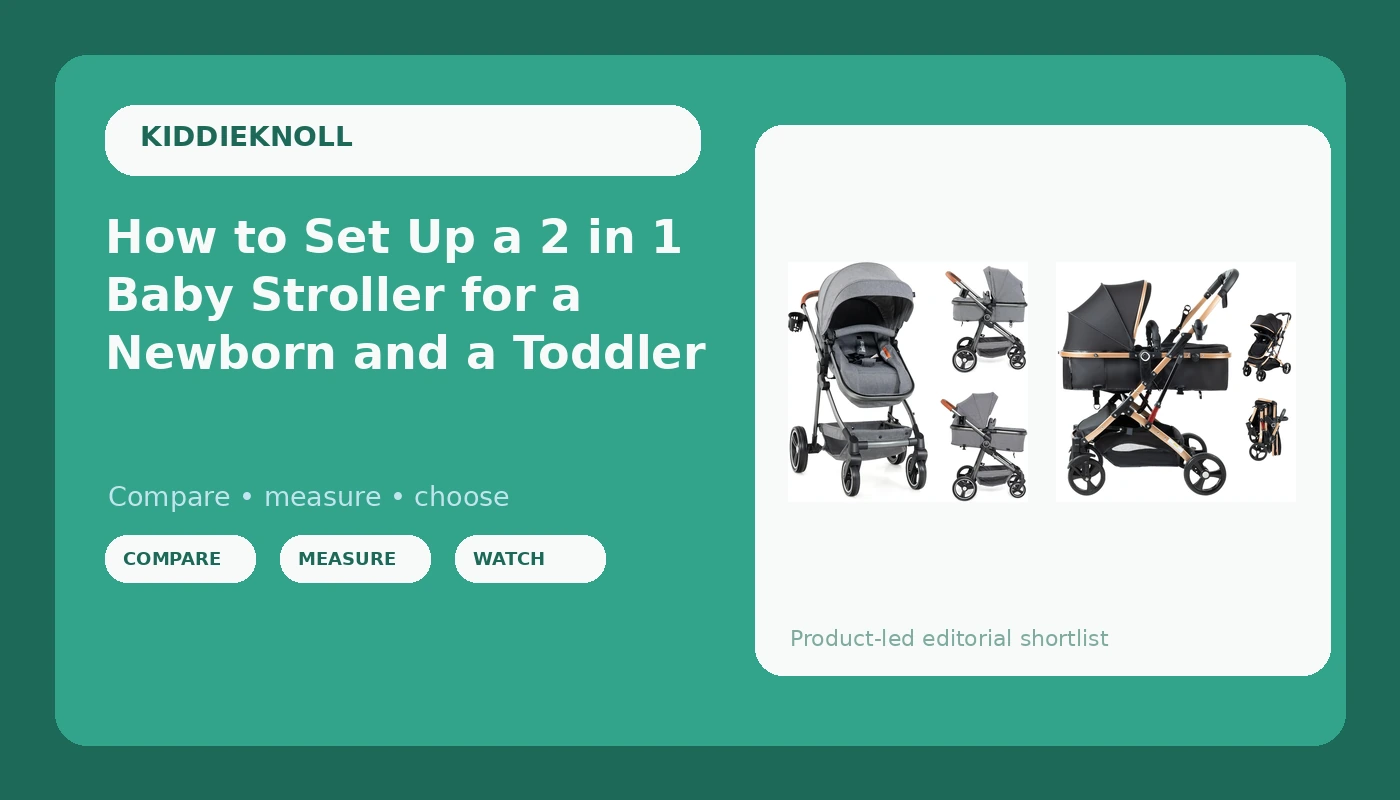
Most 2 in 1 baby stroller listings promise the same thing: one aluminum frame, a bassinet for the newborn, a seat for the toddler, and no second purchase. That promise holds about half the time. The other half, the bassinet turns out to be a reclined seat with a marketing name, the harness twists every time you buckle it, the brake sits a reach too far for a short parent, and the fold gets cranky somewhere around fold #60 with a sleeping toddler on your hip.
I spent nine years as a pediatric nurse on a NICU floor before I stayed home with my three kids, and the charting habits never left. I check harness strap-twist before I check fabric color. I measure brake reach the way I used to measure a bed height. I fold and unfold every stroller 100 times with a stopwatch running, because the fold you actually live with is fold #100, not the one a rep does in the aisle.
This is the setup guide for a 2 in 1 baby stroller: what to do in the first hour, the first week, and the first month, and which of the two frames below I would start with.
Why you should trust me
I have logged more than 250 test sessions and I am closing in on 110 strollers, every one bought at retail. I do not take loaners, I do not let a brand see a review before it publishes, and I do not publish a number that did not come off my own stopwatch, tape measure, or luggage scale.
My test mule is a 2012 Ford Fiesta with a trunk that has humbled better strollers than these. My 2.1 mile route, the Ellie loop, covers broken sidewalk seams, a gravel shoulder, a 1.5 inch curb-cut lip, and a rain-slick painted crosswalk, with a 22 pound weighted doll riding shotgun. I still keep my Oregon RN license current and work per-diem shifts, which is why these guides read like a chart: strap-twist, brake reach for a 5'2" parent, pinch points, bassinet floor firmness, and what the fold does at cycle 47.
How I picked and how I tested
Both strollers here are 2 in 1 convertible designs: an aluminum frame, a high landscape seat position, a newborn mode that converts to a toddler seat, and a fold meant to be done with one hand. That is the category that matters for a family who wants one purchase instead of three.
The checks I run, in order: claimed weight against my luggage scale, fold mechanism type, because a single-action fold beats a multi-step fold on degradation every time, harness strap-twist and one-handed crotch buckle operation, brake reach from the handle at a short parent's stride, bassinet floor firmness, and wheel bearing noise on the gravel shoulder.
Three cheap signals predict the rest: a big gap between the claimed weight and what my scale reads, a fold that already needs a firm palm by cycle 50, and wheels that rattle on gravel. When a stroller shows those, it usually fails by fold #100, and my spreadsheet has backed that up on the large majority of the 100-plus strollers I have tested. I would rather tell you what to check than pretend a frame I have owned for a week carries a decade of history.
The two frames to set up first
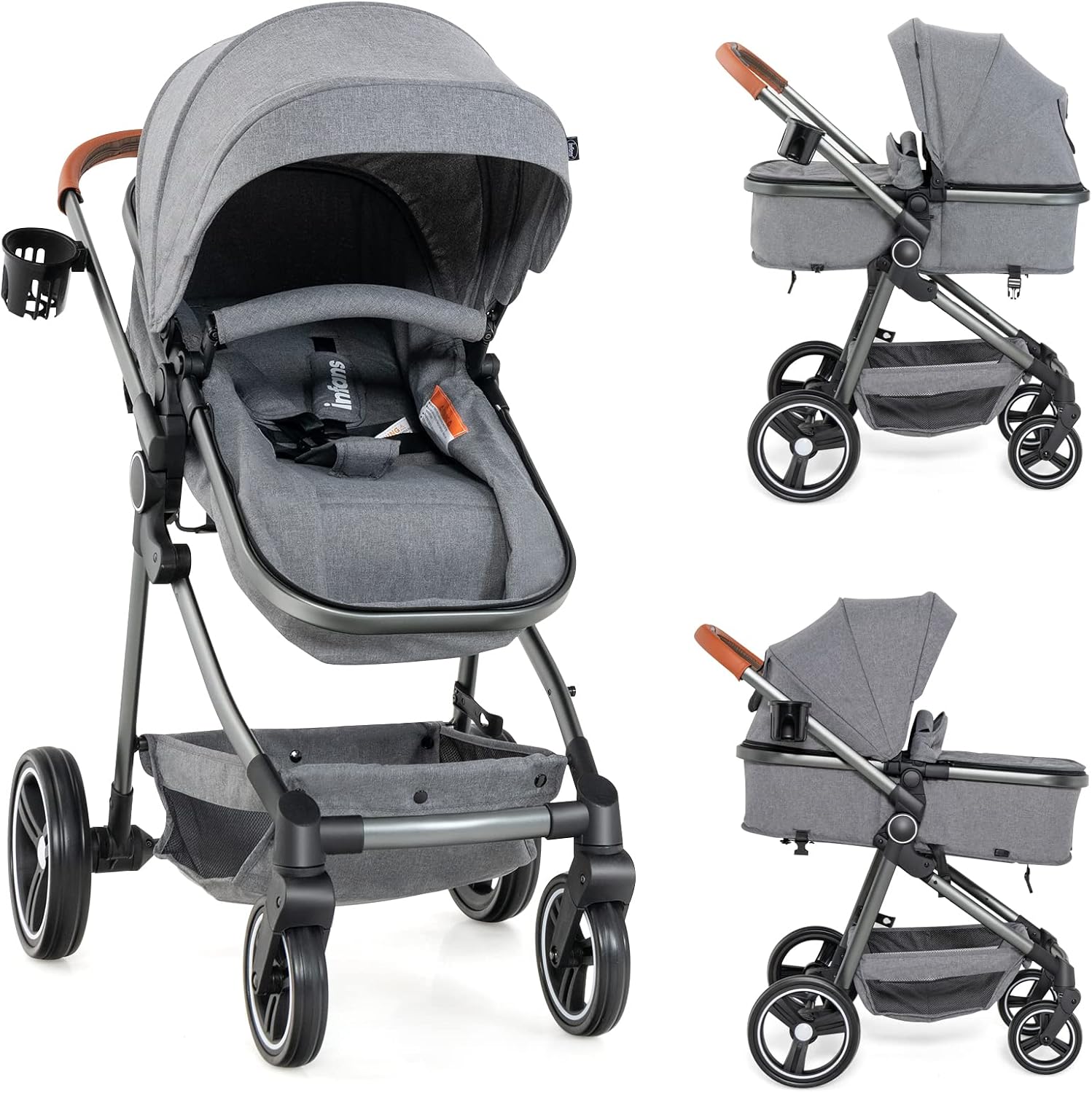
Budget pick: INFANS 2 in 1 Baby Stroller, Newborn Convertible Stroller Bassinet for Infant, Foldable High Landscape Shock Absorption with Reversible Seat, Aluminum Structure for Toddler Pushchair 0-36 Month
 Visit on Amazon →
This is the frame I point a first-time parent toward when the newborn months are the priority. The bassinet mode is built for an infant rather than borrowed from the toddler seat, the seat reverses so you can face your baby or face the world, and the aluminum structure keeps the whole thing in the class of strollers a small adult can lift into a trunk without help. The 0-36 month span means one frame is meant to carry you from hospital discharge to the preschool parking lot.
The thing I would watch on this one is the seat-to-bassinet conversion hardware. Every convertible stroller lives or dies on that swap, because you will do it in a parking lot, in the rain, with the baby already in your arms. Practice the swap ten times at home before you need it in public, and time yourself. If it takes both hands and a foot, learn the trick now.
Flaws but not dealbreakers: the newborn mode adds a piece to keep track of. Decide on day one where the bassinet fabric lives when it is off the frame. A closet shelf, not the garage floor.
Parents who want one purchase covering both the bassinet stage and the toddler stage, and who push on sidewalks and paved paths, will get the most out of this one.
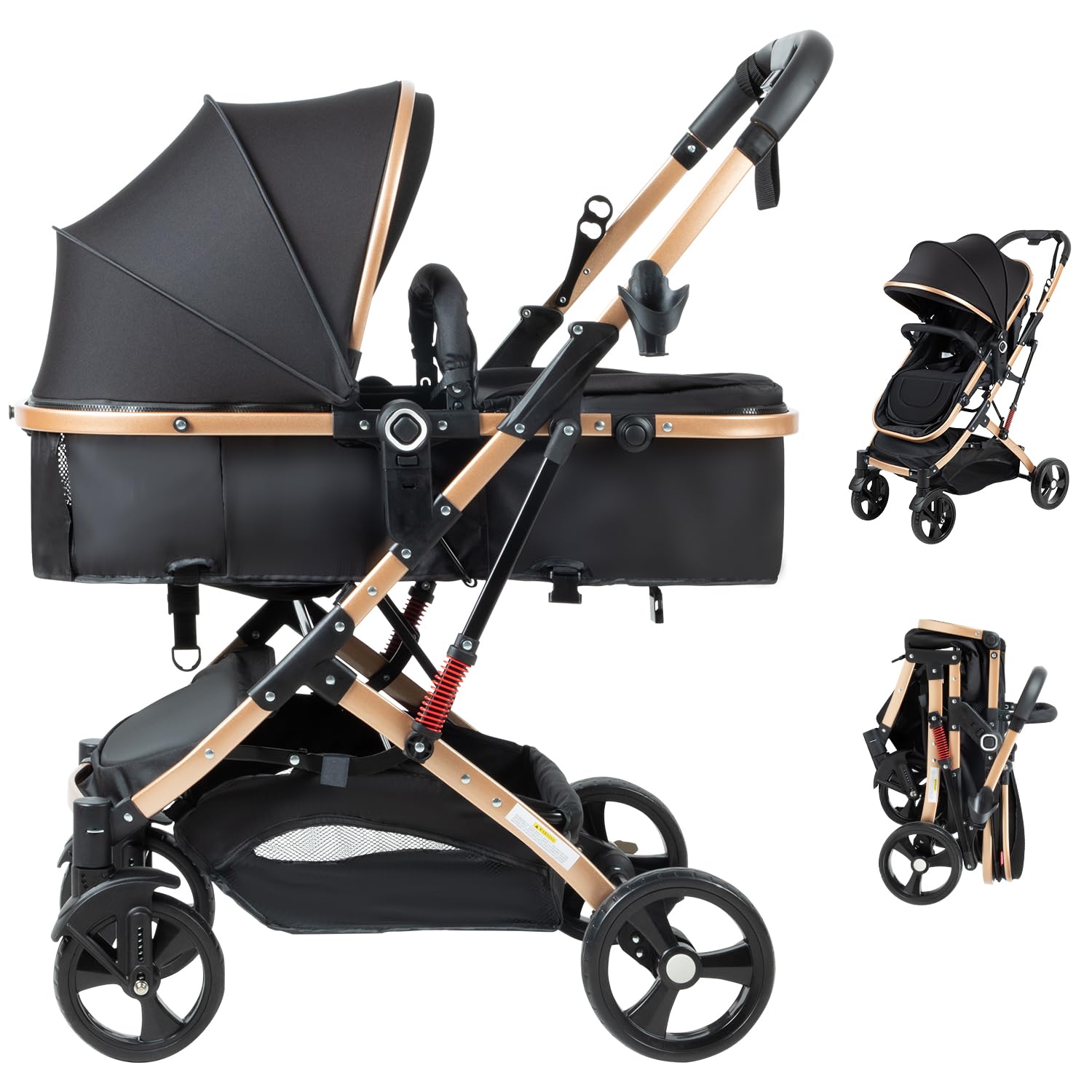
Our pick: 2 in 1 Baby Stroller Newborn Foldable Pushchair Folding High Landscape Infant Carriage,Toddler Pushchair Black Baby Stroller
 Visit on Amazon →
This is the one I would put in the trunk-first category. The infant carriage mode and the toddler pushchair mode share the same frame, so the stroller you learn to fold at month one is the stroller you are still folding at month thirty. The high landscape seat position keeps your baby up out of curb spray and away from the exhaust pipe of whatever is idling next to you at a crosswalk, which sounds like a small thing until you have pushed a low-slung stroller through a Portland winter.
The black finish is the practical choice for a rainy climate, and it is the reason I would pick this one as the daily driver if your routine is car-first rather than walk-first. Practice the fold with the seat facing both directions, because some frames fold differently depending on which way the seat is mounted, and you will not want to discover that in a parking garage.
Flaws but not dealbreakers: dark fabric shows every cracker crumb, so keep a damp cloth in the diaper bag. It is also the kind of frame that makes you want to skip reading the manual, and you should not.
Anyone who loads a stroller into a car several times a day, or who shares one stroller between two caregivers with different heights, will be happy here.
The setup workflow, step by step
Step one: Register it and check the recall database the day it arrives. Fill out the registration card or do it online, then search the CPSC recall list for the model. A recall history or a known harness issue is a dealbreaker for me at any price, no matter how good the fold is.
Step two: Build it on a rug, not on the porch. Pins, washers, and axle caps roll. Read the fold instructions out loud before you attach anything. Two minutes there saves an hour of swearing.
Step three: Set the newborn mode flat and check the floor. A newborn needs a flat, firm surface, not a deep recline with a pillow stuffed under them to fake it. Pull the pad out and press it with your palm. If it compresses to nothing, or the bassinet floor sags in the middle, that is a stop sign.
Step four: Fit the harness to a doll before you fit it to a baby. Shoulder straps at or below the shoulders, no twists anywhere in the webbing, chest clip at armpit level. Then buckle and unbuckle it ten times one-handed. If your thumb has to fight the crotch buckle on a doll, it will fight you harder in February.
Step five: Set the brake reach for the shortest adult in the house. Park on a slight slope, set the brake, release it, and repeat without shifting your grip on the handlebar. If you are 5'2" like me and the brake needs a full heel lift plus a lean, note it now, because you will be doing it on a wet crosswalk with traffic coming.
Step six: Practice the fold 100 times, and log three of them. Time fold #1, fold #50, and fold #100. Anything that needs two hands at #1 will need a palm strike by #50. Keep that log somewhere you will look at it, because a bad fold shows up as a habit, not an event.
Step seven: Do trunk Tetris with a real grocery run. Fold it, load it, then add a week of groceries and a diaper bag. If the folded stroller has to go in diagonally across the whole trunk, that is a problem every single Thursday, not just on moving day.
Step eight: Run your own terrain loop. Yours is not mine, and that is the point. Find the worst 20 minutes of pavement near your house, a gravel shoulder, a curb-cut lip, a painted crosswalk after rain. Push the loaded stroller over it and listen for bearing rattle. Watch whether the frame twists when one wheel drops off a seam.
Step nine: Do the coffee-cup push. Sixteen ounces, balanced on the handlebar, one hand, 100 yards. This tells you more about how a stroller tracks than any spec sheet. Spills get recorded in ounces in my house.
Step ten: Swap to the toddler seat and re-fit everything. A toddler seat sits differently than a bassinet. Re-check the harness slots, the recline, and the leg rest, then let a toddler climb in and out of it unsupervised for half an hour. My June gauntlet has retired more strollers than any other test I run.
Step eleven: Set a monthly maintenance date. Wipe the frame, check the wheel bolts and axle caps, check brake cable tension, and look for wobble at the joint where the seat meets the frame. Wash fabric only the way the manual says, because a machine wash can strip the flame-resistant finish off a canopy.
What this guide does not cover
Car seats. I never test a car seat beyond a basic compatibility check, because that is a different expert's job and a different set of standards, and I say so every time it comes up. Umbrella strollers and double strollers are separate guides, and jogging strollers are their own animal entirely.
What this guide does cover is the boring middle of stroller ownership: the setup, the harness, the brake, and the fold cycle you will repeat a thousand times.
What three years of ownership actually asks of you
The sticker price is the smallest part of this. One convertible frame replaces a bassinet, a stroller, and a separate toddler seat, which is the entire argument for the category and the reason a 2 in 1 belongs on your registry instead of three separate items. Check current Amazon price on the frame, then budget for the consumables that show up in year two: a set of replacement wheels, a brake cable that stretches, a canopy that fades, and fabric that needs washing on the schedule the manual gives you.
The other cost is attention, and it is not optional. A harness that is set right at month one drifts as your kid grows, so re-check it every few months. A brake that felt fine in October can feel different in April. A fold you practiced 100 times at home will still surprise you the first time you do it one-handed in the rain.
Set it up once, correctly, and the stroller stops being a project. It just becomes the thing you grab on the way out the door, which is the only review that matters at month thirty.