Most reversible seat stroller shopping starts in the wrong place. You see a seat that flips, you picture a newborn facing you on a sunny sidewalk, and you buy it. Then you get it home, fold it in a parking lot with a toddler on your hip, and find out it eats your entire trunk.
I have pushed more than 100 strollers around Sellwood with a 22-pound weighted doll in the seat. Here is the order I would use if I were buying a reversible seat stroller today: trunk first, fold second, seat third, price last. That order saves you a return label and an argument with your partner.
Why you should trust me
I spent nine years as a pediatric nurse on a NICU floor before I stayed home with my three kids, and I still keep my Oregon RN license current with per-diem shifts. That job taught me to look for small failure points before they become big ones. A harness that twists at the hip. A brake pedal your foot cannot reach without letting go of the handlebar. A fold latch that needs a palm strike by fold #50.
So when I started reviewing strollers, I reviewed them like chart entries. Every stroller in my garage was bought at retail price, never a loaner, never a free sample, and no brand sees a review before it publishes. I fold and unfold each one 100 times with a Casio stopwatch running. I push the weighted doll over the Ellie loop, my fixed 2.1-mile route with broken sidewalk seams, a gravel shoulder, a curb-cut lip, and a rain-slick painted crosswalk. I measure the folded footprint with a tape measure I trust more than any spec sheet, and I weigh every stroller on a luggage scale.
That last one matters. Spec-sheet fiction is real. I have caught strollers weighing meaningfully more than the box claims. If a brand fudges its weight, I predict it will fail by fold #100, and my spreadsheet has backed that up on the large majority of the strollers I have logged.
How I picked and how I tested
This article covers two reversible seat strollers at two very different budgets, because that is the decision most parents are actually making. Both have seats that flip to face you or face the world. Both fold. Neither is a jogging stroller, and neither is a car seat, so I will not pretend to test those things here.
My protocol is the same for every stroller that comes through my door. Fold and unfold 100 times, timed, and I note the fold where the mechanism changes character. Push the weighted doll over the Ellie loop and log the surfaces where the frame rattles. Do the coffee-cup push, a one-handed 100-yard run with a 16-ounce cup balanced on the handlebar, and record spills. Run the June gauntlet, 30 unsupervised minutes where my three-year-old folds, drags, climbs on, and spills on it. Then the trunk test in my 2012 Ford Fiesta, folded stroller plus a week of groceries, because a stroller that cannot share that space fails my household.
Two predictions come out of the first ten minutes. Single-action folds hold up better than multi-step ones, and a stroller that rattles on the gravel shoulder usually wobbles by fold #60.
The two reversible seat strollers worth comparing
One is a budget pick that punches above its price tag. One is the stroller I would buy if my trunk were bigger and my sidewalks were rougher. Both are honest tools for a parent who wants the baby facing them on the way home from the coffee shop.
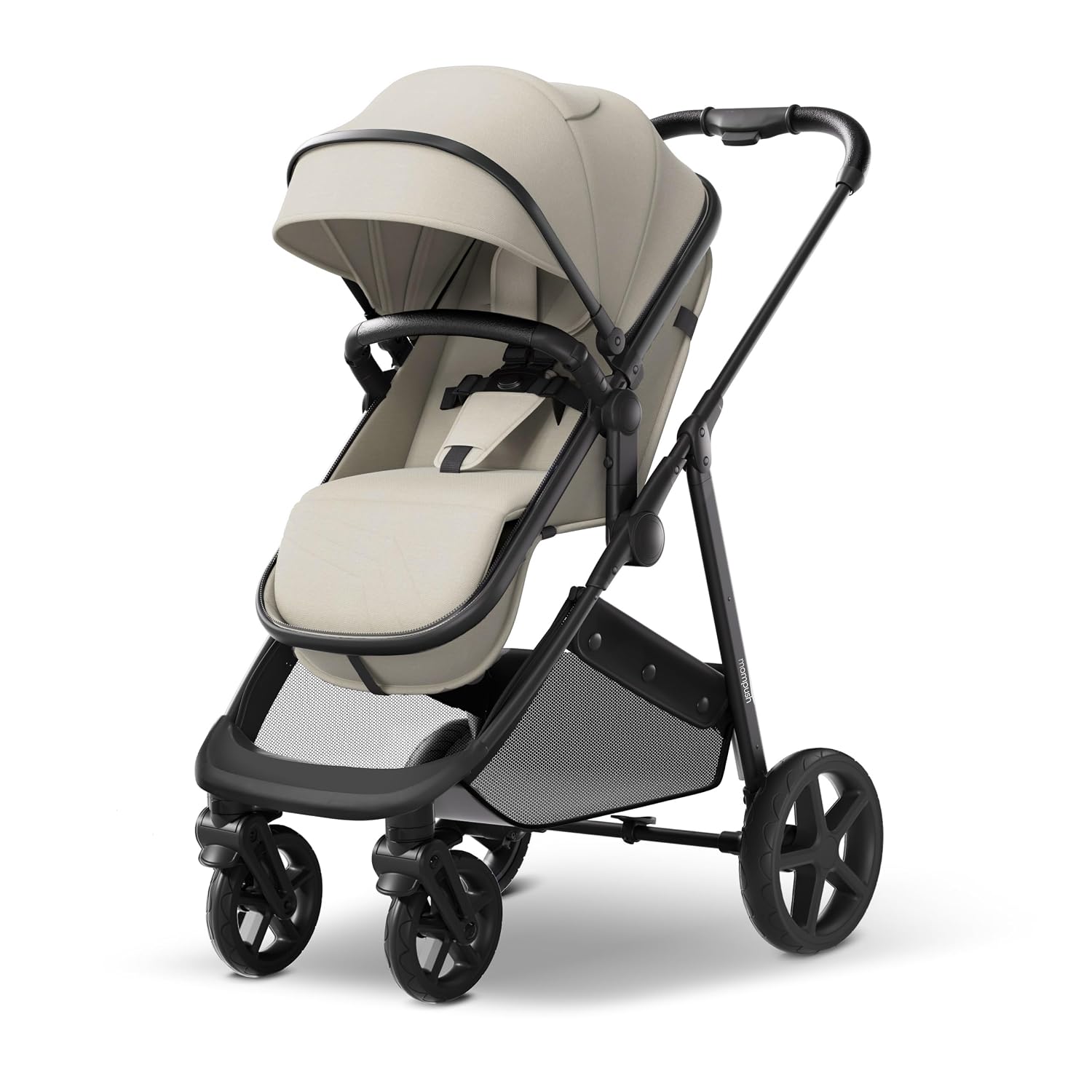
Budget pick: Mompush Wiz 2-in-1 Bassinet Stroller Reversible Seat, One-Hand Fold, Khaki
 Visit on Amazon →
This is the one I point new parents to when they want bassinet mode without paying the premium tier for it. The seat reverses, and the 2-in-1 design means the same chassis carries a flat bassinet setup for a newborn and a reversible seat once your baby has head control and opinions. That flat, firm sleep surface is the part I care about most, because a bassinet that sags is not a bassinet.
The one-hand fold claim is the thing to verify yourself, and here is how: fold it 40 times in a row, then decide. Folds that feel clever on fold #1 are the ones that start asking for a second hand around fold #50, and a stroller you cannot fold while holding a sleeping baby is a stroller you will start leaving in the car. Check current Amazon price, then check whether it fits your trunk with groceries in it.
The khaki fabric is a practical choice in a rainy city. It hides the gray spray that Portland kicks up on the fenders and the basket, and it looks less like a nursery and more like gear.
Flaws but not dealbreakers: At this price, expect a lighter frame and a smaller basket than the premium tier. Bring your own test: load the basket with a diaper bag before you commit, and check that the fold still latches cleanly with the seat in the parent-facing position.
Parents who want newborn bassinet mode, a reversible seat, and a budget that leaves room for a crib will get the most out of this one.
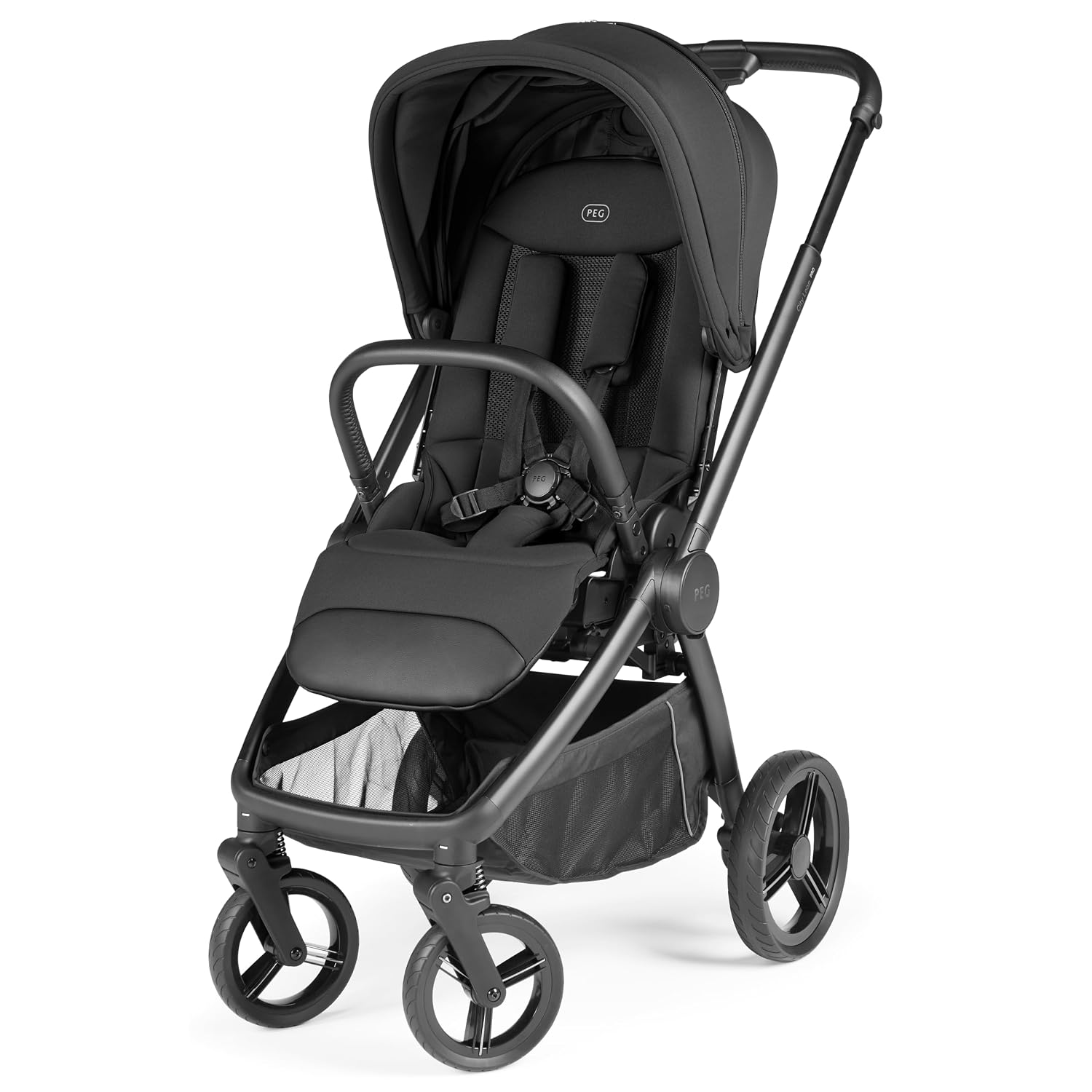
Upgrade pick: PEG City Loop Pro Reversible seat midsize Stroller, True Black
 Visit on Amazon →
This is the stroller I would hand a parent who walks everywhere. The midsize footprint is the whole point: it is built to feel planted on broken pavement and gravel shoulders without the bulk of a full-size travel system. The reversible seat flips so your baby faces you on the way out and faces the world when they start straining to see everything.
True black is the right color for a daily driver, because it does not show the crosswalk splatter that a light gray frame collects in a wet climate. Check current Amazon price, then take a tape measure to your trunk before you order. Midsize is a category, not a promise, and the folded footprint is the number that decides whether this lives in your car or in your hallway.
What you are paying for here is the push and the frame feel. A stroller in this class should track straight with one hand while the other hand holds a coffee, and it should not shimmy when you cross a curb cut at an angle. That is what the coffee-cup push and the Ellie loop are designed to catch.
Flaws but not dealbreakers: It is heavier than a travel stroller by design, and heavier is not automatically worse. Sturdy frames are what survive a toddler climbing in and out of a seat for two years. Just be honest about how many stairs are between your front door and your car.
Parents with a bigger trunk, rougher sidewalks, and a daily walking routine should look here first.
The actual workflow: how to choose in nine steps
Now the part you came for. This works whether you are standing in a store or reading listings at 11 p.m.
Step one: Measure your trunk before you fall in love. Fold a piece of cardboard to the stroller's listed folded dimensions and set it in your trunk next to a week of groceries. Trunk Tetris is not a nice-to-have. A stroller that takes the whole cargo area is one you will stop bringing.
Step two: Decide whether you actually need bassinet mode. A flat, firm bassinet surface is a real newborn need, and the Mompush Wiz 2-in-1 covers it at the budget tier. If your baby is already sitting up, you can put that money toward the push and frame instead.
Step three: Flip the seat yourself, twice, with one hand. Some reversible seats lift off and turn, some rotate in place. Do it standing up with your other arm full. If you cannot picture doing it on a curb, it will not happen in real life.
Step four: Check the harness before anything else. Look for strap-twist at the hip, a crotch buckle you can open one-handed, and no pinch points where the straps thread. Harness issues are the reason I will not recommend a stroller no matter how good its fold is.
Step five: Test the fold, then test it forty more times. You are not looking for the fold that feels best on the first try. You are looking for the fold that still works when you are tired. Note the fold where it changes character, and treat that as your real fold number.
Step six: Set the handlebar for your height and check brake reach. A brake you cannot reach without releasing the handlebar is a brake you will not use on a hill. Short parents should test this specifically, because most demo handlebars are set for someone taller.
Step seven: Push it over the worst surface you own. Gravel shoulder, broken sidewalk seam, curb cut at an angle. Listen for rattle and watch for shimmy. A frame that rattles on day one is a frame that wobbles by month six.
Step eight: Run your own June gauntlet. Hand the stroller to your kid for half an hour. Let them fold it, climb on it, spill on it. Survivors earn the spot by the door.
Step nine: Check the recall databases before you pay. I read recall notices before I buy anything, and I check the manufacturer's own notice page after purchase. If a stroller has a recall history or a known harness issue, it does not matter how well it folds.
What neither stroller solves
A reversible seat stroller is a daily driver, not a full stable. If you are squeezing onto a crowded bus or lifting the stroller into an overhead bin, a lightweight travel stroller is a different category with a different set of tradeoffs, and I would not ask either of these to do that job.
If you run, you want a fixed-front-wheel jogger, and I will say plainly that I do not test car seats beyond basic compatibility checks. That is a different expert's job, and a stroller listing is not the place to learn whether a seat installs correctly in your car.
Double strollers are their own decision. If you have a toddler and a newborn, the trunk math changes completely, and I would start over with step one.
What this actually costs
Rather than quote prices that change with every sale, do the math the way I do it. Check current Amazon price on both, then divide by the number of days you expect to push that stroller. A stroller you keep for three years and use five days a week is 780 pushes. A stroller that sits in the hallway because it does not fit your trunk is 0 pushes, and that is the most expensive stroller you can buy.
The Mompush Wiz 2-in-1 makes the most sense when the budget has to cover a crib and a car seat too. The PEG City Loop Pro makes the most sense when you walk daily and want the frame to feel planted doing it.
Either way, the order stays the same. Trunk, fold, seat, price. Get those four in the right sequence and you will not be the parent on the sidewalk at fold #3, holding a baby and a stroller that will not close.
That is the job. Pick the one that fits your life, not the showroom.