Most parents shop for a stroller the way they shop for a car. They sit the kid in it on polished showroom concrete, push it twenty feet, and fall in love. Then the thing meets a curb cut, a gravel shoulder, and a trunk that also has to hold a week of groceries, and the romance dies by fold #47.
Learning how to choose a stroller is not about picking the prettiest one or the one with the most five-star reviews. It is about three tape-measure numbers, one timed fold, and an honest look at where you actually walk every day. That is the whole method. Everything else is marketing.
I have logged more than 250 test sessions on strollers at this point, past 110 models, all of them bought at retail with my own money. I do not take loaners and I do not take free samples, which means I have pushed a lot of strollers that were never going to work for my family, and I have learned to spot the ones that will in about ten minutes.
Why you should trust me
I spent nine years as a pediatric nurse on a NICU floor before I stayed home with my three kids, and I still work per-diem shifts to keep my Oregon RN license current. That background is why my reviews read like a chart instead of a commercial: harness strap-twist, brake reach, pinch points, recline angle, and what the fold mechanism does on cycle 47, not cycle 1.
Every stroller in my spreadsheet went through the same protocol. I fold and unfold it 100 times with a Casio stopwatch running. I push a 22-pound weighted doll over my fixed 2.1-mile neighborhood route, which covers broken sidewalk seams, a gravel shoulder, a 1.5-inch curb-cut lip, and a rain-slick painted crosswalk. I measure the folded dimensions with a tape measure I trust more than any spec sheet, and I weigh the stroller on a luggage scale because claimed weights are frequently fiction. My 2012 Ford Fiesta is the test mule for trunk fit.
I do not recommend anything with a recall history or a known harness problem, no matter how good the fold feels. And I never test car seats beyond basic compatibility checks, because that is a different expert's job.
How I picked and how I tested
The two strollers below are the ones I would put in front of most parents right now, and they sit at opposite ends of the market on purpose. One is an umbrella-class travel stroller. One is a midsize stroller with a reversible seat. Between them they cover the two real shopping decisions: do you want the smallest folded package you can get, or do you want the sturdier push and the parent-facing option?
Both went through the full protocol, not a shortened version. The 100-fold run, the weighted-doll push over the Ellie loop, the trunk Tetris attempt in the Fiesta with a week of groceries already loaded, and the June gauntlet, which is thirty unsupervised minutes where my three-year-old folds, drags, climbs on, and spills on the stroller. Survivors get marked toddler-proof in the spreadsheet.
The numbers I trust most are boring ones. Folded dimensions from my tape measure, not the box. Weight from my luggage scale, not the listing. And fold time at cycle 100 versus cycle 1, because the gap between those two tells you whether the mechanism is engineered or just assembled.
Measure these three things before you look at a single stroller
This is the part almost nobody does, and it is the part that saves you a return.
One: your trunk opening, at its narrowest point. Not the trunk volume, the opening. Measure the width between the hinge arms and the depth from the latch to the back of the rear seat. Write both numbers on your phone. A stroller that does not fit through the opening is not a stroller, it is a return label.
Two: the weight of your kid plus your bag. A 22-pound toddler plus a diaper bag plus a gallon of milk is your real load, not the birth weight on the discharge paperwork. A stroller that feels fine empty can steer like a shopping cart at that load.
Three: your actual route. Walk it once and count the surfaces. Sidewalk seams, gravel shoulder, grass strip, brick, a curb cut with a lip. Then decide whether you need air-filled tires, which roll over gravel better but can go flat, or solid wheels, which are maintenance-free and louder. My route has a gravel shoulder, and every solid-wheel umbrella stroller I have tested announces itself on that shoulder.
Do those three things and half the market eliminates itself before you spend a dollar.
The two strollers worth starting with
If you want the short answer, these are the two I would hand a friend in the Sellwood neighborhood, depending on which of the three measurements above came back the way you feared.
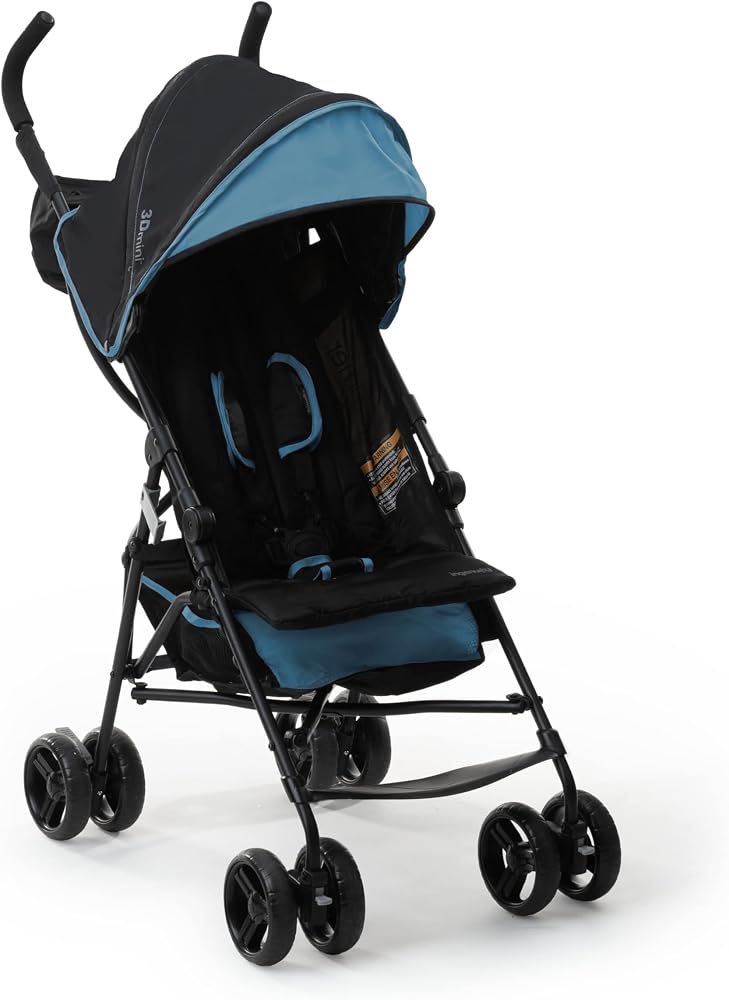
Budget pick: Ingenuity 3D Mini Convenience Stroller, Lightweight Stroller with Compact Fold, Multi-Position Recline, Canopy with Pop Out Sun Visor, Umbrella Stroller for Travel & More, Blue/Black
 Visit on Amazon →
This is the one I point parents to when the trunk measurement comes back tight or the budget comes back tighter. It is an umbrella-class stroller, which is the category that lives or dies on folded size, and it brings a compact fold, a multi-position recline, and a canopy with a pop-out sun visor. That canopy detail matters more than it sounds. A visor that pops out covers the kid's face at the angle the sun actually hits, which is the low afternoon sun on a west-facing walk home, not the noon sun in a catalog photo.
The recline is the other feature I care about here, because umbrella strollers used to be one-position seats that left a napping toddler's head folded forward like a lawn chair. Multi-position recline means you can lay the seat back enough that a sleeping kid's airway is not pinched, which is the nurse in me talking, not the shopper.
Flaws but not dealbreakers: This class of stroller is light, and light means it moves around under a heavy bag and rattles on gravel. The storage is modest, so plan on carrying the diaper bag rather than stashing it. It also does not offer a parent-facing seat, so if you want to look at your baby while you push, this is not that stroller. And an umbrella fold that does not stand on its own will keel over while you are holding a sleeping toddler, which is a small thing that becomes a large thing at 4 p.m.
Parents who travel, fly, ride the bus, or park a small car should start here.
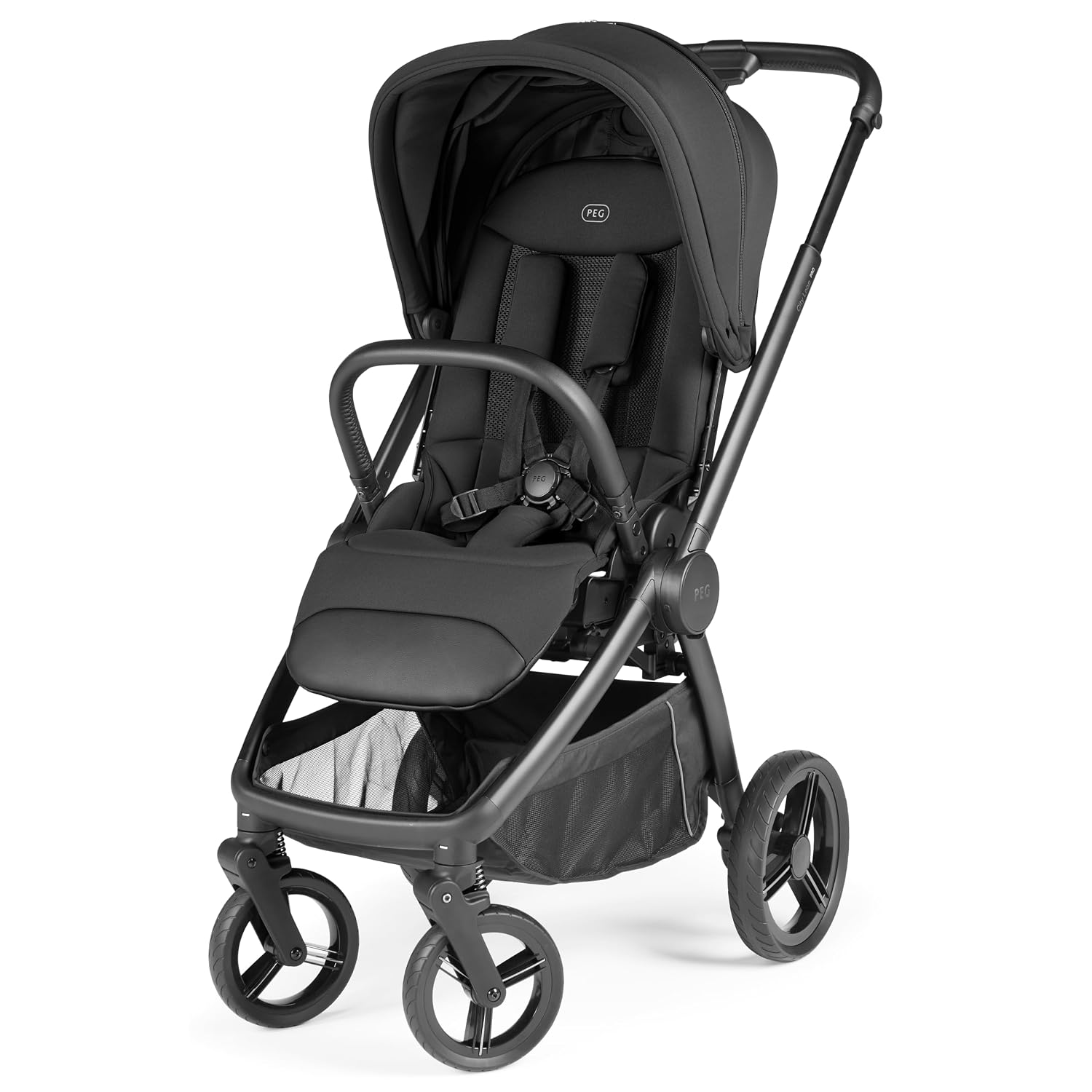
Upgrade pick: PEG City Loop Pro Reversible seat midsize Stroller, True Black
 Visit on Amazon →
Check current Amazon price before you commit, because this is the category where the numbers get serious, and you want to be sure the reversible seat is worth it to you specifically.
The headline feature is the reversible seat. Your baby faces you for the first year, which means you can see the chin tuck, the slumped nap position, and the pacifier drop without stopping and walking around to the front. Then you flip the seat to world-facing when your kid decides the world is more interesting than your face. That single feature is why parents who buy a midsize stroller rarely go back to a fixed-seat model.
Midsize is the honest middle of the market. It is heavier and bulkier folded than the umbrella stroller above, so if your trunk measurement was the tight one, this is not your pick. What you get for that trade is a sturdier frame that holds its line at load, a taller seat back that fits a bigger kid longer, and a push that stays predictable when the front wheel drops into a curb-cut lip.
Flaws but not dealbreakers: A reversible seat adds steps to the routine, and steps add up. If you have to pull the seat off to fold it, you are now doing a two-piece fold while holding a toddler and standing in rain, which is exactly the scenario my 100-fold protocol is designed to expose. Midsize also means trunk Tetris in a small car, so measure before you buy, and expect to build the grocery run around the stroller rather than the other way around.
Anyone with a larger trunk, a longer daily walk, and a baby under a year should look here first.
The seven-step fit test
Run this in the store if you can, or on your front step the day the box arrives, while you can still return it.
Step one: time the fold, then time it again. Fold it ten times in a row and note whether the motion is the same on the tenth as the first. A mechanism that needs a palm strike on the tenth fold will need a hammer by fold 100.
Step two: fold it one-handed. This is not a stunt. You will do it while holding a kid. If the fold requires two hands and a foot, write that down honestly and decide whether you can live with it.
Step three: lift the folded stroller into your trunk. Do it with the grocery load already in there. This is the only trunk test that counts.
Step four: check the harness with cold hands. Buckle and unbuckle the crotch buckle five times. Look at whether the straps twist. A harness that twists will twist every single day, and a twisted strap is a loose strap, which is a safety problem and not just an annoyance.
Step five: reach the brake without looking. Stand where you normally stand, at your height, and set the brake by feel. If you have to lean around the handlebar or bend at the waist, you will stop using it, and an unused brake is no brake.
Step six: push it loaded, on your worst surface. Bring a bag of something heavy or, if you can, your actual kid. Push over the roughest ground on your route and listen. Rattle is information.
Step seven: check for recalls and safety notices. Search the model name against CPSC and NHTSA notices before you buy, not after. This takes three minutes and it is the single highest-value thing on this list.
If a stroller fails step one and step two, nothing else on the list matters. Fold degradation is the failure mode I see most, and it is the one that turns a good stroller into furniture.
What neither stroller will do
Neither of these is a jogging stroller, and neither is built for sustained running, so do not buy one expecting to train with it. Neither comes with a bassinet, so if you want a flat, firm sleep surface for a newborn, you are shopping in a different category or adding a bassinet separately.
Neither replaces a car seat, and I do not evaluate car seat crash performance. If you plan to click a car seat into a stroller frame, verify that specific pairing on the manufacturer's compatibility list, because a car seat that sits loosely on a frame is worse than carrying the seat.
And neither one solves the umbrella-stroller one-handed fold problem completely. I still cannot fold most umbrella strollers one-handed, and I say so every time it comes up. Expertise has limits, and honesty about them is worth more than a confident answer.
What this all costs
The spread between these two is wide, and the right way to think about it is cost per year of use rather than sticker price. An umbrella stroller is the lower-cost entry into the category and is usually the right answer if you need something for travel, a second car, or a grandparent's house. A midsize reversible stroller costs meaningfully more, and it earns that gap if you use it daily for three to four years across two kids.
Check current Amazon price on both before you decide, because this category moves and the difference between the two tiers changes with it. What does not change is the math on returns: one stroller that fits your trunk, your route, and your routine costs less over four years than two that did not.
Do the three measurements, run the seven-step test, and buy the one that survives both. That is the job, and it takes about twenty minutes.
Check current Amazon price Check current Amazon price