Most parents shop for a stroller the way they shop for a couch: four minutes in a bright showroom, a nod at the price tag, and a hope that it works out. Then the baby arrives, the trunk turns out to be smaller than the showroom floor, and the stroller becomes furniture you drag in and out of the car twice a day.
Knowing how to choose a stroller comes down to three numbers and one habit. The numbers are folded size, harness fit, and the weight you actually lift. The habit is how many times a day you fold the thing, because a mechanism that feels clever on fold #1 is a different animal on fold #100.
I spent nine years as a pediatric nurse before I stayed home with my three kids, and I have bought every stroller I have ever reviewed at retail price. Nobody loans me anything. That is the only way I know to be honest about a product that is going to carry a newborn.
Why you should trust me
I worked NICU for nine years and I still keep my Oregon RN license current with per diem shifts. On a NICU floor you learn to spot the small failure points before they become big ones: a strap that twists, a buckle that needs two hands, a latch that needs a palm strike. That is the lens I bring to strollers.
I test in Sellwood, in Portland, Oregon, on the same broken sidewalks and gravel shoulders I push my own kids over. I am past 250 logged test sessions and closing in on 110 strollers. Every one of them was bought with my own money, and every number I publish comes off my own Casio stopwatch, my luggage scale, or a tape measure I trust more than any spec sheet. If I did not measure it, I do not print it.
How I picked and how I tested
Every stroller that gets written up here runs the same protocol.
I fold and unfold it 100 times with a stopwatch running and log the time of each cycle. I weigh it on a luggage scale, because claimed weight and measured weight are two different sports. I measure the folded dimensions with a tape measure instead of copying the listing. I push a 22-pound weighted doll over a fixed 2.1-mile route I call the Ellie loop: broken sidewalk seams, a gravel shoulder, a 1.5-inch curb-cut lip, and a rain-slick painted crosswalk. I do a coffee-cup push, one-handed, 100 yards, with a 16-ounce cup balanced on the bar, and I count the spills in ounces. Then the stroller goes through the June gauntlet, which is 30 unsupervised minutes with my three-year-old. Survivors get marked toddler-proof.
The two strollers below are the two I would put in front of a parent deciding between a stroller that does everything and a stroller that disappears into a trunk. They sit at opposite ends of that decision, and for a lot of families the honest answer is that you eventually want both. Run the steps further down on the showroom floor before you commit to either.
The two strollers that answer this decision
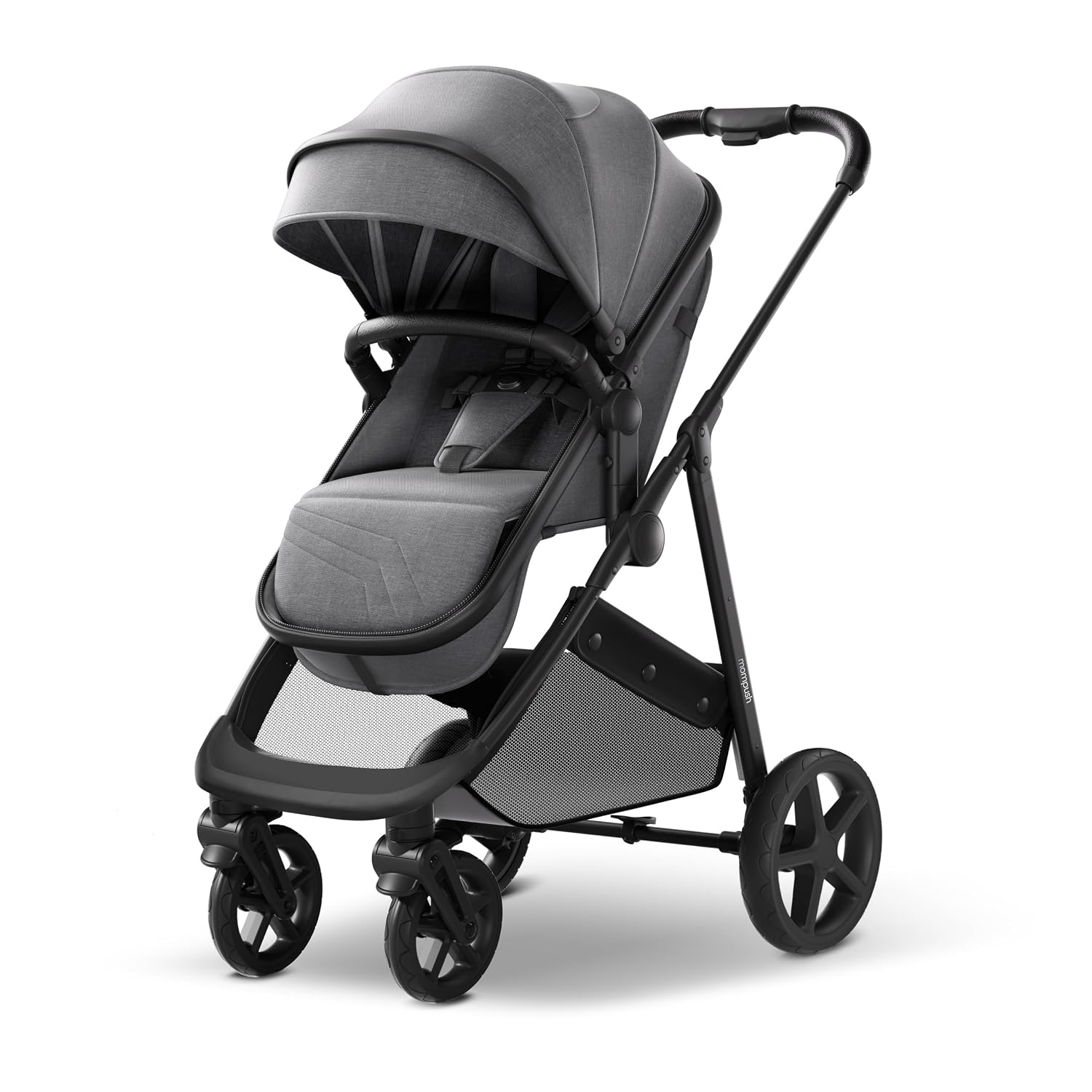
The do-everything pick: Mompush Wiz 2-in-1 Bassinet Stroller Reversible Seat, One-Hand Fold, Grey
 Visit on Amazon →
This is the stroller I point new parents toward when they want one purchase to cover the first year. The bassinet mode matters more than people expect: a newborn should lie flat and firm, not slumped in a reclined toddler seat, so a stroller that converts gives you a safe place to lay a baby down on a walk without buying a second piece of gear. The reversible seat means you can face the baby toward you when they are small and turn them outward when they start wanting to see the world. The one-hand fold is the feature I would actually pay for, because the moment you need it is the moment your other arm is holding a sleeping infant.
What to check on the floor: put one hand on the fold and one hand on your hip, then fold it. If you cannot do it while holding something, the feature is marketing. Then run your thumb down the harness straps looking for twist, and see whether the crotch buckle releases with one thumb.
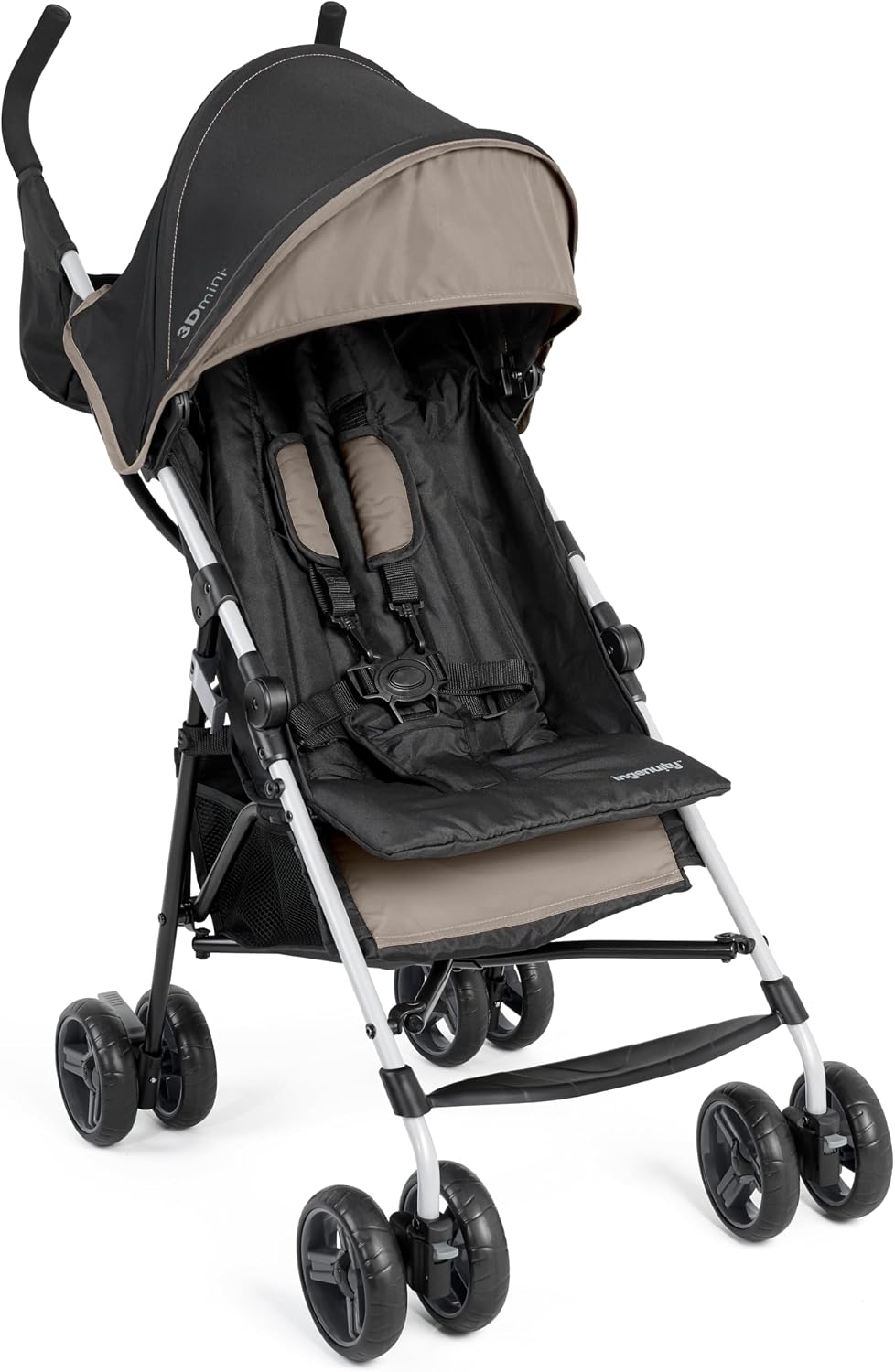
The travel and small-trunk pick: Ingenuity 3D Mini Convenience Stroller, Lightweight Stroller with Compact Fold, Multi-Position Recline, Canopy with Pop Out Sun Visor, Umbrella Stroller for Travel and More, Cashew Tan
 Visit on Amazon →
This is the second-stroller answer, or the only-stroller answer for a family in an apartment who mostly walks to the park. It is an umbrella-style stroller, which means the design priority is weight and folded size, not cargo capacity. The multi-position recline is the feature that separates it from the cheap umbrella strollers your parents used: a toddler can nap in it without their head flopping forward. The canopy with the pop-out sun visor is the piece that matters in a Portland summer, because the sun moves across the seat and a fixed canopy stops helping by 4 p.m.
The honest caveat about this class of stroller is that I have never met an umbrella stroller I could fold one-handed while holding a baby, and I say that in every review of one. Test the fold with both hands before you buy, and check whether it stands on its own when folded, because a stroller that keels over in a parking lot is a stroller you will resent.
The actual decision workflow
Step one: Measure your trunk before you look at anything else. Take a tape measure to your car. You want the narrowest dimension of the trunk opening, the height from the trunk floor to the parcel shelf, and the depth. Write all three on your phone. A stroller that fits two of the three is a stroller that does not fit.
Step two: Weigh the kid you have, not the kid on the box. Stroller weight limits are generous and mostly useless. What matters is the weight you lift when you load the car. Put the folded stroller on a luggage scale at the store if they let you, or at home inside the return window.
Step three: Decide whether you need newborn mode. If you are buying before the baby arrives, you need a flat, firm sleep surface or a car seat adapter, not just a reclined seat. If your youngest is already sitting up, skip that and spend the money on a better fold instead.
Step four: Count your daily folds. Write down every time you will fold the stroller in a normal day: into the car, out of the car, into the closet, onto a bus. If that number is four or higher, the fold mechanism is the single most important feature you are buying.
Step five: Test the fold standing up, one-handed, holding something. This is the only fold test that matters. Put a bag of groceries in your other hand if the store staff will allow it. If the fold needs two hands and a foot, you will stop folding it and start leaving it in the car.
Step six: Check the harness like a nurse. Run your thumb along each strap and look for twist. Twist is the failure that hides, because the strap looks fine until the day it is not. Fasten and release the crotch buckle one-handed, several times. Then check the brake with the shoes you actually wear, because brake reach is a real problem for a shorter parent.
Step seven: Match the wheels to your terrain. Smooth sidewalks and mall floors tolerate small hard wheels. Gravel shoulders, brick, and tree roots do not. If your daily route looks like the Ellie loop, prioritize wheel size over folded size.
Step eight: Plan for the second stroller instead of pretending you will not buy one. Most families end up with a full-feature stroller and a light travel one. Budgeting for both from the start is cheaper than buying a compromise stroller twice.
Where this decision usually goes wrong
The biggest mistake is trusting the spec sheet. Claimed weight and measured weight diverge more often than they match, and folded dimensions are frequently the optimistic version. If a listing will not give you folded dimensions at all, that tells you something.
The second mistake is buying the travel stroller first. A lightweight umbrella is a wonderful second stroller and a frustrating only stroller for a newborn, because it cannot lie flat enough and the basket holds a jacket and not much else.
The third is buying for the showroom. A stroller that glides on polished concrete can rattle your teeth on a gravel shoulder. Push it outside before you decide.
The fourth is skipping the recall check. Before you buy anything, search the brand and model in the CPSC recall database. A great fold does not matter if the product has a harness notice against it.
The strollers that did not make this article
Full-size convertible strollers, jogging strollers, and double strollers are all real categories, and none of them belong in a guide about fitting a stroller into a small trunk and a small routine. A full-size convertible is the right answer if you have a garage, a big vehicle, and one child who will ride for years. A jogging stroller is the right answer if you actually run. A double is the right answer the moment you have two kids who both need to ride, and no single stroller solves that.
The point is that the category has to match the routine. If your routine is a compact car, a flight twice a year, and a walk to the coffee shop, the two strollers above cover the whole job between them.
What this all costs
I am not going to quote you a price, because prices move and the number on the page today is not the number you will pay. Check current Amazon price on each of the two strollers above and compare them against each other, not against a dream stroller you saw in a showroom.
What I can tell you is how to think about the spend. A stroller you keep for three years and use twice a day gets used more than two thousand times. A stroller that lives in your trunk because it is too annoying to fold gets used a dozen times and then sits in the garage. The cheap stroller you never use is the expensive one.
If you can only buy one, buy the one that matches your most common trip, not your most exciting trip. If your most common trip is the car, the compact fold matters more than the bassinet. If your most common trip is a walk from home with a newborn, the bassinet mode matters more than the fold. And if you can stretch to two, buy the do-everything stroller first and add the light one when the baby is sitting up.
The bottom line
Choosing a stroller is a measurement problem dressed up as a taste problem. Measure your trunk, weigh the stroller yourself, count your daily folds, and check the harness and the brake with your own hands. Do that in the ten minutes you would otherwise spend reading a spec sheet, and you will not be the parent dragging furniture through a parking lot in February.