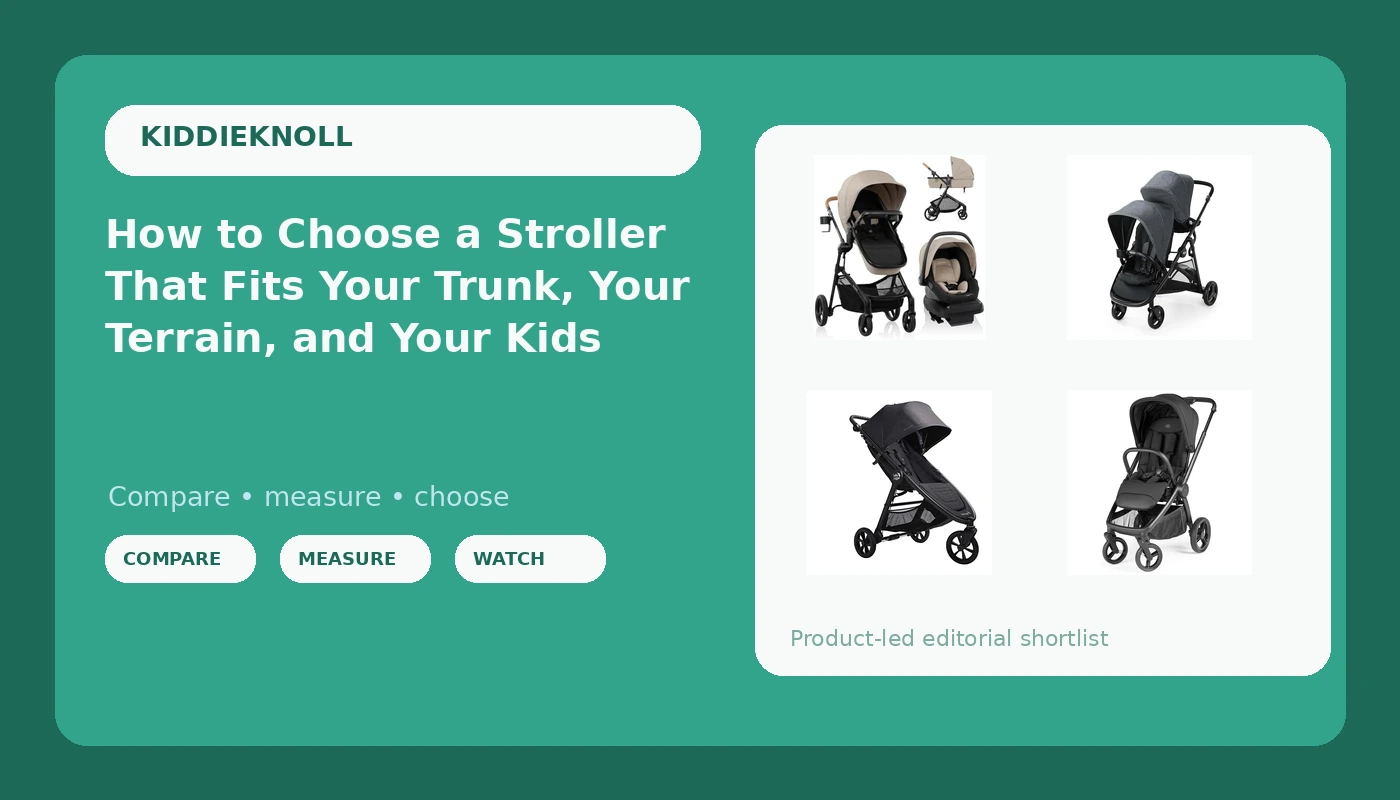
Stroller shopping goes sideways for the same reason most gear shopping does: the categories overlap, and the marketing never tells you which one you actually need. A travel system, a double, an all-terrain push, and a reversible-seat midsize stroller can each be described as the perfect stroller, and each can be wrong for your hallway. Knowing how to choose a stroller really comes down to three questions you can answer before you open a single listing: where will this live when it is folded, what surface will you push it across on an ordinary Tuesday, and how many children need a seat at the same time. Get those answers on paper and the shortlist almost writes itself. The four strollers below represent four different answers, and the sections after them explain how to pick between them without guessing.
Related: How to Fit a Folded Stroller in a Small Car Trunk →
Quick answer
A stroller is only right when it matches your fold-and-carry routine, your usual terrain, and your rider count. If a newborn is the priority and you want the infant car seat to double as the stroller seat, a travel system covers the most ground with one purchase. If two children ride at once and one is old enough to sit or stand on a platform, a double with flexible seating does work a single stroller cannot. If your daily route is gravel, broken sidewalk, or an unpaved shoulder, an all-terrain frame with a hand-operated brake is the more stable push. If you want the seat to face you and later face forward, a reversible-seat midsize is the most flexible single-rider format. None of these is universally better; each is better for a specific routine. Confirm the current manufacturer specifications, weight limits, and any recall notices for the exact model before you buy.
Four useful options
| Model | Best fit | What stands out |
|---|---|---|
| PEG City Loop Pro Reversible seat midsize Stroller, True Black | Parents who want the seat to face either direction | Reversible seat on a midsize frame |
| Evenflo Pivot NXT Travel System with LiteMax NXT Preemie and Infant Car Seat | Newborn-first buyers who want stroller and car seat together | Sold as a matched stroller and infant car seat set |
| Graco Ready2Grow 2.0 Double Stroller, Twin Baby Stroller Features Bench Seat and Standing Platform Options, Compact Fold Perfect for Baby Travel, Rafa | Households with two riders of different ages | Bench seat and standing platform options plus a compact fold |
| Baby Jogger City Mini GT2 All-Terrain Stroller Black Complete with Adjustable Handlebar Hand-Operated Parking Brake and car seat Adapter | Rough pavement, gravel, and mixed surfaces | All-terrain build with adjustable handlebar, hand brake, and included car seat adapter |
The reversible-seat pick: PEG City Loop Pro Reversible seat midsize Stroller, True Black
A reversible seat is the feature parents underestimate most, because it changes what the stroller is for. Facing a newborn toward you keeps you in visual contact and lets you watch breathing and color on the walk home, which matters a great deal in the first months. Flipping the seat forward later gives a toddler the view they will demand. The trade-off is mechanical: reversible seats add a second set of attachment points, so they tend to weigh more than a fixed-seat stroller of similar size and they give you one more joint to check for a solid click every single time. If you only ever want one stroller for one child and you care about the seat direction, this is the format that solves that problem. If you want the smallest possible folded package, a fixed-seat compact will usually beat it.
The travel system pick: Evenflo Pivot NXT Travel System with LiteMax NXT Preemie and Infant Car Seat
The appeal of a travel system is that it removes an entire category of shopping mistakes. When the stroller and the car seat are sold as a matched pair, you are not hunting through compatibility charts or hoping an adapter exists for a discontinued seat. The trade-off is commitment. You are buying into one brand's ecosystem, and the stroller portion of a travel system is often built around the car seat rather than around years of toddler use, so think about whether you want a separate stroller later. Two checks belong on your list before you commit: the car seat's stated height and weight limits, and its expiration date, since infant seats carry one. A preemie-rated seat is worth noting if you expect a small baby, but the seat still has to be installed correctly in the vehicle, and that is a job for the car seat manual and a certified technician, not a stroller article.
The double pick: Graco Ready2Grow 2.0 Double Stroller, Twin Baby Stroller Features Bench Seat and Standing Platform Options, Compact Fold Perfect for Baby Travel, Rafa
Doubles split into two shapes, and the shape decides where you can take it. Side-by-side doubles are easy for both children to see out of, but they are wide, which is a real problem in narrow doorways, older shops, and crowded sidewalks. Inline doubles are narrower but longer, which changes how they turn and how much trunk depth they need. The seating arrangement on this one leans toward a mixed-age household: a bench seat and a standing platform are for a child who can climb up and hold on, which is a different job from a reclining seat for a baby. That makes it a strong candidate when you have a newborn and a preschooler. If you have twins of the same age who both need to recline and nap, check the seating and recline options carefully against what the manufacturer states for each position.
The all-terrain pick: Baby Jogger City Mini GT2 All-Terrain Stroller Black Complete with Adjustable Handlebar Hand-Operated Parking Brake and car seat Adapter
Two features on this stroller are worth more than they sound. An adjustable handlebar matters because a handle that sits too high or too low changes your wrist angle and your posture for the whole walk, and parents of very different heights share strollers constantly. A hand-operated parking brake matters on hills and on wet, painted crosswalks, because it gives you control you can reach without hunting for a foot pedal. All-terrain is not a synonym for jogging, though. Bigger wheels and a sturdier frame handle cracks, gravel shoulders, and curb-cut lips better than small hard wheels, but running with a stroller is a separate question that only the manufacturer's manual can answer for a specific model. Expect the all-terrain trade-off in the other direction too: more wheel and more frame usually means more weight and a larger folded package.
Prices and availability may change. Product images, names, and retailer links are matched to verified listings. No current price, rating, stock status, or measured result is stated here without current evidence.
What the four formats actually mean
A travel system is a stroller and an infant car seat sold as a set, usually with the car seat able to click onto the stroller frame. Its strength is the newborn stage, when a sleeping baby can move from car to stroller without being unbuckled. Its limits show up later, when the child outgrows the infant seat and the stroller has to stand on its own as a toddler stroller.
A double stroller is any stroller designed for two children at once, and it comes in two layouts. Side-by-side models put both seats next to each other, which is simple and fair but wide. Inline models stack the seats front to back, which fits narrow spaces but is longer and turns differently. Some inline doubles also offer a bench seat or a standing platform, which is aimed at an older sibling rather than a second baby.
An all-terrain stroller uses larger wheels and a heavier frame to cope with gravel, dirt paths, broken pavement, and unpaved shoulders. It is not automatically a jogging stroller, and the manual is the only authority on whether a model is approved for running. All-terrain designs also tend to weigh more and fold larger than pavement-only strollers.
A reversible-seat stroller lets the seat face the parent or face forward. It is the most flexible single-rider format for the first year, when parent-facing contact is useful, and the second year, when a toddler wants the view. It adds hardware, so it is rarely the lightest option in its size class.
How to decide before you buy
- Measure your trunk with a tape measure, in inches, for length, width, and height at the opening. A stroller fails in daily life if it cannot share that space with groceries.
- Measure the tightest doorway, hallway, or elevator you use regularly. This is where side-by-side doubles get ruled in or out.
- Count riders and their ages. One baby, a baby plus a preschooler, and twins of the same age are three different shopping lists.
- Name your real terrain. If most of your miles are smooth store floors and sidewalks, you do not need to pay for all-terrain hardware, and if most of your miles are gravel, a small-wheeled compact will fight you.
- Check the CPSC recall database and the manufacturer's current manual for the exact model before you buy, and confirm the stated weight limits for the seat and for any car seat you plan to attach.
What to check before you commit
- Fold and unfold the stroller several times in the store, and pay attention to whether it latches without a hard shove.
- Check whether the folded stroller stands on its own, since that matters when you are holding a child with one arm.
- Test the harness buckles one-handed, and look for straps that twist easily, because a twisted strap is harder to tighten correctly.
- Push with one hand and see whether the stroller tracks straight, which tells you more about the wheels than any spec sheet.
- Sit the handlebar at your own height before deciding, especially if two adults of different heights will share it.
- Confirm that the infant car seat you own, or plan to buy, is listed as compatible with the stroller you are considering.
Which option should you choose?
Choose the PEG City Loop Pro Reversible seat midsize Stroller, True Black when you want one stroller for one child and the ability to switch the seat between parent-facing and forward-facing positions. Choose the Evenflo Pivot NXT Travel System with LiteMax NXT Preemie and Infant Car Seat when a newborn is arriving, you want the car seat and stroller to work as one matched set, and you would rather not research adapters. Choose the Graco Ready2Grow 2.0 Double Stroller when two children ride at once and the older one is ready for a bench seat or a standing platform. Choose the Baby Jogger City Mini GT2 All-Terrain Stroller when your regular route includes gravel, rough pavement, or uneven shoulders and you want an adjustable handlebar, a hand-operated brake, and a car seat adapter included.
Two caveats belong here. This article does not state prices, ratings, or measured results, because those change and because no testing is claimed for these specific units; verify current specifications, weight limits, and recall status on the manufacturer's site and in the federal recall database before you buy. Car seat installation and fit in a vehicle are a separate expertise from stroller shopping, so have the seat checked by a certified technician rather than relying on a stroller review.
The bottom line
The stroller that works is the one that matches three measurable things about your life: the space it has to fold into, the surface it gets pushed across, and the number of children who need a seat at the same time. Travel systems solve the newborn stage in one purchase. Reversible-seat midsize strollers solve the seat-direction question for a single child. Inline doubles with flexible seating solve the baby-plus-older-sibling problem. All-terrain strollers solve rough ground, at the cost of weight and folded size. Pick the format first, then compare the specific models inside it against your trunk measurement, your doorway width, and the current manufacturer manual. That order of operations is what keeps a stroller out of the graveyard of gear you regret.